Diisopropylethylamine → (S)-2-[4-(2-chloro-phenoxy)-2-oxo-2,5-dihydro-pyrrol-1-yl]-4-methyl-hexanoic acid [1-((R)-2,2-dimethyl-[1,3]dioxolan-4-ylmethyl)-1H-pyrazol-3-yl]-amide
Reaction equation

[Cl:1][C:2]1[CH:23]=[CH:22][CH:21]=[CH:20][C:3]=1[O:4][C:5]1[CH2:9][N:8]([C@@H:10]([CH2:14][CH:15]([CH3:18])[CH2:16][CH3:17])[C:11]([OH:13])=O)[C:7](=[O:19])[CH:6]=1.[CH3:24][C:25]1([CH3:37])[O:29][C@H:28]([CH2:30][N:31]2[CH:35]=[CH:34][C:33]([NH2:36])=[N:32]2)[CH2:27][O:26]1.C(N(CC)C(C)C)(C)C.F[P-](F)(F)(F)(F)F.N1(O[P+](N(C)C)(N(C)C)N(C)C)C2C=CC=CC=2N=N1>CN(C)C=O>[CH3:24][C:25]1([CH3:37])[O:29][C@H:28]([CH2:30][N:31]2[CH:35]=[CH:34][C:33]([NH:36][C:11](=[O:13])[C@@H:10]([N:8]3[CH2:9][C:5]([O:4][C:3]4[CH:20]=[CH:21][CH:22]=[CH:23][C:2]=4[Cl:1])=[CH:6][C:7]3=[O:19])[CH2:14][CH:15]([CH3:18])[CH2:16][CH3:17])=[N:32]2)[CH2:27][O:26]1Participants
Reactant 4



Product 1

Reagents, catalysts & solvents 1

Procedure
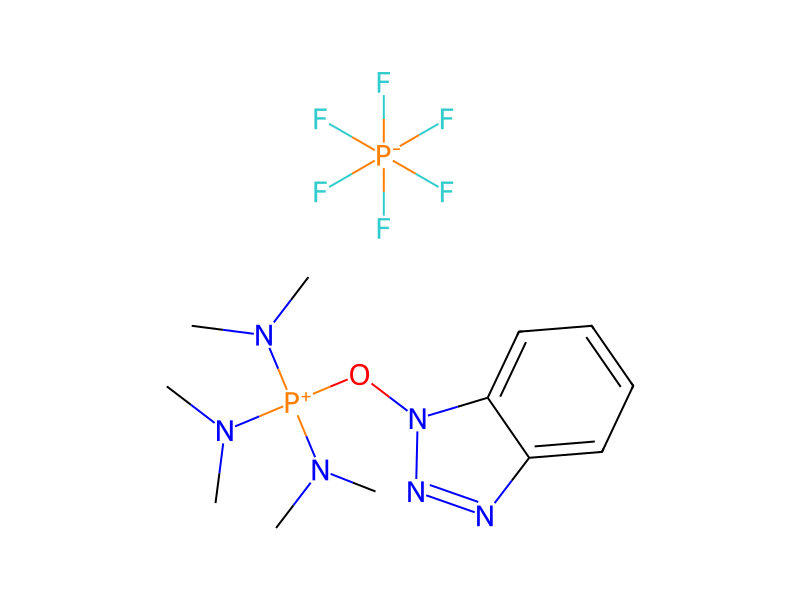
A solution of (S)-2-[4-(2-chloro-phenoxy)-2-oxo-2,5-dihydro-pyrrol-1-yl]-4-methyl-hexanoic acid (337 mg, 1 mmol), 1-((R)-2,2-dimethyl-[1,3]dioxolan-4-yl-methyl)-1H-pyrazol-3-ylamine (prepared as in Example 49, 276 mg, 1.4 mmol) in N,N-dimethylformamide (7 mL) was treated with N,N-diisopropylethylamine (0.46 mL) and benzotriazol-1-yl-oxy-tris(dimethylamino)phosphonium hexafluorophosphate (664 mg, 1.5 mmol) and stirred at room temperature for 6 h. The mixture was concentrated in vacuo and the residue was partitioned between ethyl acetate and an aqueous ammonium chloride solution. The layers were separated and the organic layer washed with brine and dried with sodium sulfate. The mixture was filtered and the filterate concentrated in vacuo and the residue was purified by ISCO flash chromatography (RediSep silica column 40 g, 20% to 80% ethyl acetate/hexanes) which afforded (S)-2-[4-(2-chloro-phenoxy)-2-oxo-2,5-dihydro-pyrrol-1-yl]-4-methyl-hexanoic acid [1-((R)-2,2-dimethyl-[1,3]dioxolan-4-ylmethyl)-1H-pyrazol-3-yl]-amide (400 mg, 76%) as a pale yellow solid: HR-ES-MS (m/z) calculated for C26H33ClN4O5 [M+H]+ 517.2212, observed 517.2209. 1H NMR showed mixture of diastereomers (300 MHz, DMSO-d6) δ ppm 0.75-0.95 (m, 6H), 1.02-1.23 (m, 2H), 1.25 (s, 3H), 1.31 (s, 3H), 1.40-1.93 (m, 3H), 3.73 (dd, J=8.5, 5.7 Hz, 1H), 4.00 (dd, J=8.3, 6.5 Hz, 1H), 4.04-4.28 (m, 3H), 4.35 (quin, J=5.7 Hz, 1H), 4.60 (dd, J=18.4, 14.5 Hz, 1H), 4.80 (2×s, 1H), 4.86-4.96 (m, 1H), 6.42-6.46 (m, 1H), 7.37 (t, J=7.5 Hz, 1H), 7.42-7.57 (m, 2H), 7.60 (s, 1H), 7.65 (d, J=7.8 Hz, 1H), 10.76-10.84 (m, 1H).
Workup
- concentrationThe mixture was concentrated in vacuo
- customthe residue was partitioned between ethyl acetate
- customThe layers were separated
- washthe organic layer washed with brine
- dry with materialdried with sodium sulfate
- filtrationThe mixture was filtered
- concentrationthe filterate concentrated in vacuo
- customthe residue was purified by ISCO flash chromatography (RediSep silica column 40 g, 20% to 80% ethyl acetate/hexanes) which
Sources & evidence
- ORD record
- ord-e0c5bdbc810045f8a2cee0b1282cb583
- Source dataset
- uspto-grants-2010_06
- Patent number
- US07741327B2
Reaction notes
Loading…