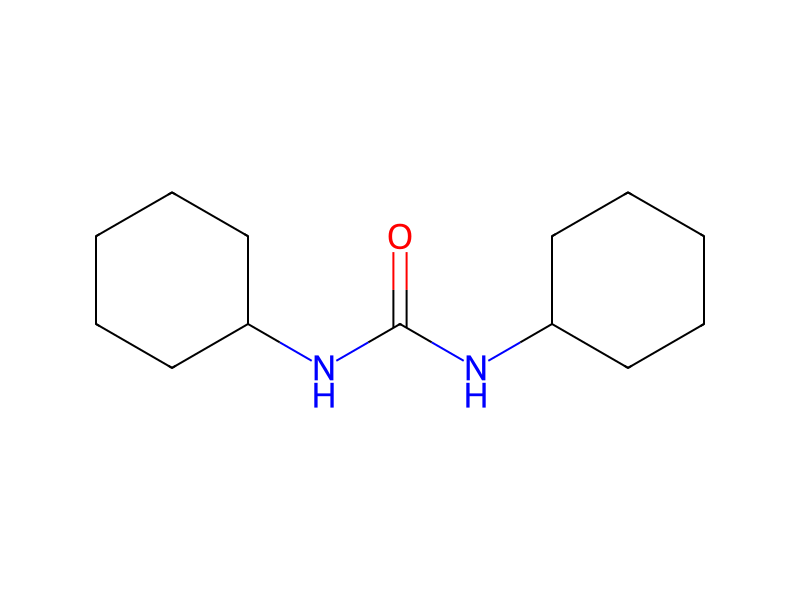
Dicyclohexylcarbodiimide → N,N'-Dicyclohexylurea
Reaction equation

[Na+].[OH:2]C1C=CC(S([O-])(=O)=O)=CC=1[N+]([O-])=O.[CH:16]1([N:22]=[C:23]=[N:24][CH:25]2[CH2:30][CH2:29][CH2:28][CH2:27][CH2:26]2)[CH2:21][CH2:20][CH2:19][CH2:18][CH2:17]1.C1(=O)N(NCCCCCC(O)=O)C(=O)C=C1>CN(C)C=O>[CH:25]1([NH:24][C:23]([NH:22][CH:16]2[CH2:17][CH2:18][CH2:19][CH2:20][CH2:21]2)=[O:2])[CH2:30][CH2:29][CH2:28][CH2:27][CH2:26]1Participants
5
Reactant 3



Product 1
Reagents, catalysts & solvents 1

Procedure
One molar equivalent (2.24 g) of 4-hydroxy-3-nitro-benzene sulfonic acid sodium salt (HNSA) is mixed together with one molar equivalent (2.06 g) of dicyclohexylcarbodiimide and one molar equivalent (2.10 g) of N-maleimido-6-aminocaproic acid in 25 ml of dimethylformamide (DMF) at room temperature overnight. A white precipitate of dicyclohexyl urea is formed. The precipitate is filtered and 300 ml diethyl ether is added to the mother liquor. After about 10 minutes to 4 hours a gummy solid precipitated from the mother liquor is formed. This solid will contain 58% of active HNSA ester and 42% of free HNSA.
Sources & evidence
- ORD record
- ord-a2540c656a7442d295abd19d31160c9a
- Source dataset
- uspto-grants-1997_12
- Patent number
- US05702705
Reaction notes
Loading…