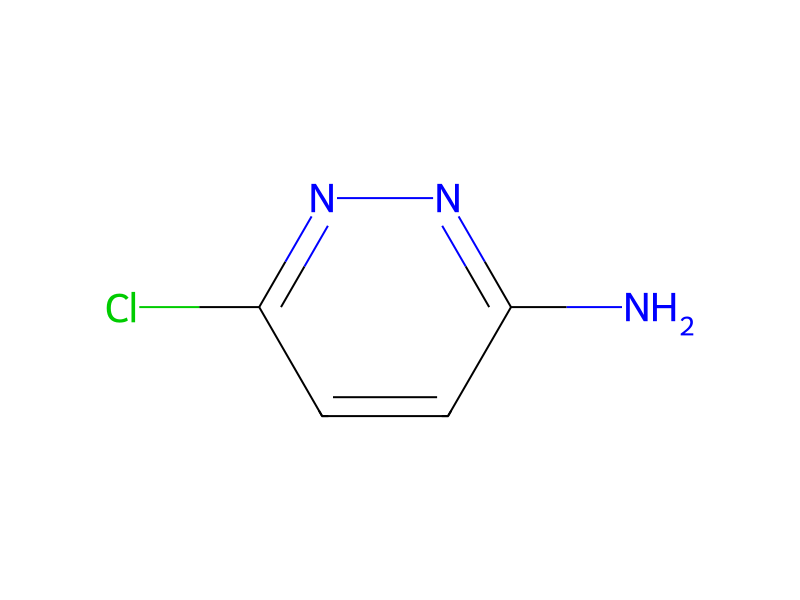
6-Amino-3-chloropyridazine → 3-Amino-4-bromo-6-chloropyridazine
Reaction equation

[Cl:1][C:2]1[N:7]=[N:6][C:5]([NH2:8])=[CH:4][CH:3]=1.C(=O)(O)[O-].[Na+].[Br:14]Br>C(O)C>[Br:14][C:4]1[CH:3]=[C:2]([Cl:1])[N:7]=[N:6][C:5]=1[NH2:8]Participants
Reactant 3


Product 1

Reagents, catalysts & solvents 1

Procedure
To a 250 mL round-bottomed flask was added 6-chloropyridazin-3-amine (3.92 g, 30.3 mmol), sodium bicarbonate (5.08 g, 60.5 mmol) and ethanol (20 mL). To the resulting solution, bromine (1.559 mL, 30.3 mmol) was added dropwise. The resulting mixture was stirred at room temperature for 16 hours. The solution was filtered and then concentrated in vacuo. The residue was dissolved in water and the product extracted with ethyl acetate (3×). The organic layers were combined, dried over anhydrous sodium sulfate and concentrated in vacuo to give 4-bromo-6-chloropyridazin-3-amine (4.5 g, 21.59 mmol, 71.3% yield). LC/MS, m/z 207.88 (M+1). HPLC Rt, 1.25 min. Waters Sunfire C18 column (4.6×50 mm) 0%-100% B. Solvent B: (90% MeOH, 10% H2O, 0.1% TFA). Solvent A: (10% MeOH, 90% H2O, 0.1% TFA). Gradient, start % B=0, final % B=100, gradient time 4 min, hold at 100% B 1 min, flow rate 4 mL/min.
Workup
- filtrationThe solution was filtered
- concentrationconcentrated in vacuo
- dissolutionThe residue was dissolved in water
- extractionthe product extracted with ethyl acetate (3×)
- dry with materialdried over anhydrous sodium sulfate
- concentrationconcentrated in vacuo
Sources & evidence
- ORD record
- ord-beb5787ec687481c8485b11a4b4a2c48
- Source dataset
- uspto-grants-2013_03
- Patent number
- US08389527B2
Reaction notes
Loading…