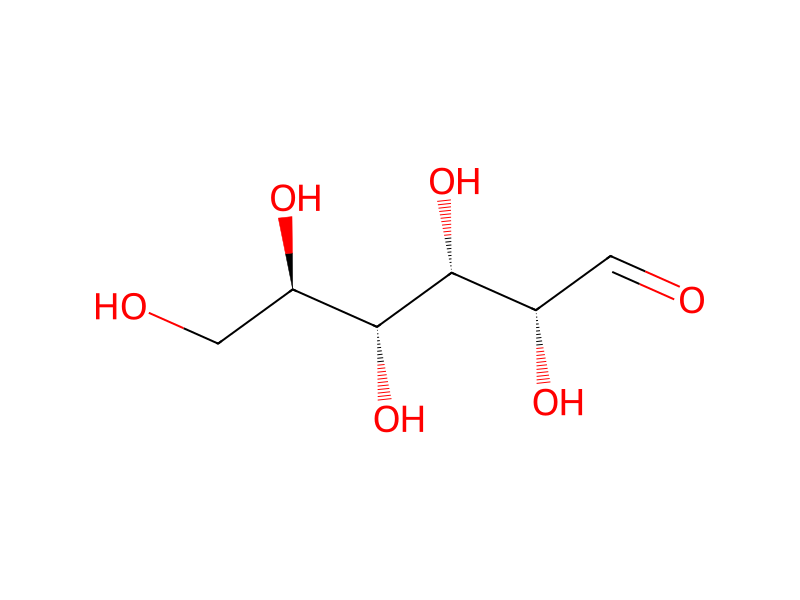
Water → (2R,3S,4R,5R)-2,3,4,5,6-pentahydroxyhexanal
Reaction equation

[O:1]=[CH:2][C@@H:3]([C@H:5]([C@@H:7]([C@@H:9]([CH2:11][OH:12])[OH:10])[OH:8])[OH:6])[OH:4].[OH2:13]>>[O:13]=[O:1].[O:1]=[CH:2][C@@H:3]([C@H:5]([C@@H:7]([C@@H:9]([CH2:11][OH:12])[OH:10])[OH:8])[OH:6])[OH:4].[O:1]=[CH:2][C@@H:3]([C@H:5]([C@@H:7]([C@@H:9]([CH2:11][OH:12])[OH:10])[OH:8])[OH:6])[OH:4]Participants


Procedure
In preparing the NMR samples, the MVo-glucose reaction was run in 98% D2O (deuterium oxide). The reaction proceeded at a slower rate compared to corresponding reactions conducted in H2O. Closer examination showed that after approximately 3 hours (approximately 60% oxidation of glucose), a nearly two-fold slower reaction had occurred in D2O compared to the same reaction conducted in H2O. For reactions conducted over 6-8 hours, a O2/glucose ratio value of 5.7 (6.0 is expected for complete oxidation of glucose) and 3.7 were obtained in H2O and D2O, respectively, indicating that D2O severely retarded the final stages of glucose oxidation by air. The isotope effect from oxidizing glucose in D2O is consistent with data obtained from anaerobic oxidation of glucose, i.e., that ionization of a proton with a pKa of approximately 10 works more effectively.
Workup
- customIn preparing the NMR samples
- customafter approximately 3 hours
- customa nearly two-fold slower reaction
- customcompared to the same reaction
Sources & evidence
- ORD record
- ord-57db300592674f0fbe887aa71538fdc6
- Source dataset
- uspto-grants-2013_03
- Patent number
- US08404396B2
Reaction notes
Loading…