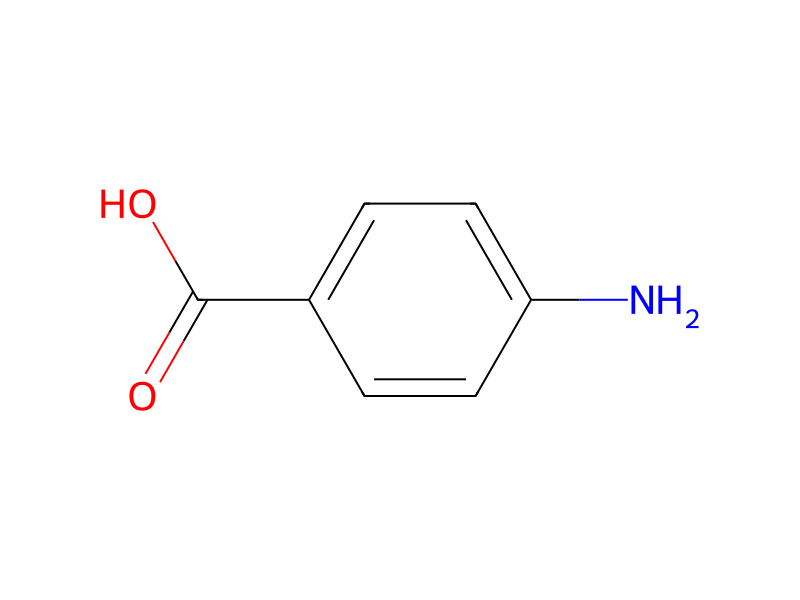
4-Aminobenzoic Acid → 4-(2-Chlorobenzamido)benzoic acid
Reaction equation

[NH2:1][C:2]1[CH:10]=[CH:9][C:5]([C:6]([OH:8])=[O:7])=[CH:4][CH:3]=1.[Cl:11][C:12]1[CH:20]=[CH:19][CH:18]=[CH:17][C:13]=1[C:14](Cl)=[O:15].C(N(CC)CC)C>C(#N)C>[Cl:11][C:12]1[CH:20]=[CH:19][CH:18]=[CH:17][C:13]=1[C:14]([NH:1][C:2]1[CH:10]=[CH:9][C:5]([C:6]([OH:8])=[O:7])=[CH:4][CH:3]=1)=[O:15]Participants
Reactant 3


Product 1

Reagents, catalysts & solvents 1

Procedure
under an N2 atmosphere, 4-aminobenzoic acid (2.50 g, 18.2 mmol) was dissolved in acetonitrile (100 ml) and treated with 2-chlorobenzoyl chloride (2.43 ml, 19.1 mmol). Triethylamine (2.66 ml, 19.1 mmol) was added and the reaction was allowed to stir at room temperature for four hours. The reaction was concentrated in vacuo, and the resulting solid was partitioned between Et2O and 0.5N NaOH. The layers were separated and the organic layer was discarded. The aqueous layer was acidified to pH 2 with HCl and the aqueous layer was extracted with ethyl acetate. The organic layer was dried Na2SO4, filtered and concentrated in vacuo. The resulting solid was triturated with Et2O, and the solid was collected by filtration to afford 4-(2-chlorobenzamido)benzoic acid (2.72 g, 54.2% yield). ESI m/z=276.1 (M+H+).
Workup
- concentrationThe reaction was concentrated in vacuo
- customthe resulting solid was partitioned between Et2O and 0.5N NaOH
- customThe layers were separated
- extractionthe aqueous layer was extracted with ethyl acetate
- filtrationfiltered
- concentrationconcentrated in vacuo
- customThe resulting solid was triturated with Et2O
- filtrationthe solid was collected by filtration
Sources & evidence
- ORD record
- ord-f7828a428a6740bfaeb3b3fecd1c9803
- Source dataset
- uspto-grants-2013_03
- Patent number
- US08404722B2
Reaction notes
Loading…