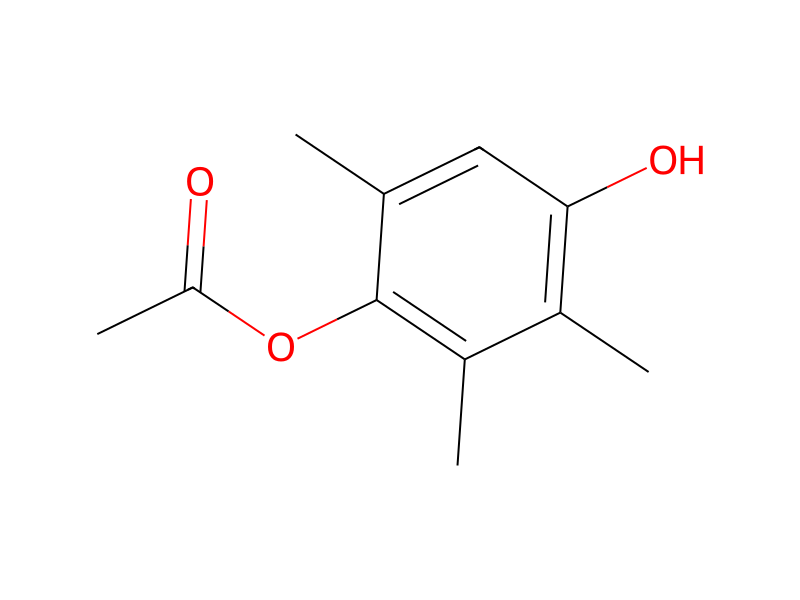
Diethyl Ether → 4-Hydroxy-2,3,6-trimethylphenyl acetate
Reaction equation

[CH3:1][C:2]1[C:3]([OH:11])=[C:4]([CH3:10])[C:5]([CH3:9])=[C:6]([CH:8]=1)[OH:7].C(N(CC)CC)C.[CH3:19][CH2:20][O:21]CC.C(Cl)(=O)C>O>[C:20]([O:11][C:3]1[C:2]([CH3:1])=[CH:8][C:6]([OH:7])=[C:5]([CH3:9])[C:4]=1[CH3:10])(=[O:21])[CH3:19]Participants
6
Reactant 4




Product 1
Reagents, catalysts & solvents 1

Procedure
Stir a mixture of trimethylhydroquinone (15.2 g, 0.1 mol), triethylamine (25.3 g, 0.25 mol) and ether (500 mL) in an ice bath. Slowly add acetylchloride (19.6 g, 0.25 mol) with stirring, allow the reaction to warm to room temperature for an hour, then dilute with water and the separate the layers. Evaporate the ether layer to dryness. Dissolve the resulting diacetate in methanol (300 mL). Add strong ammonium hydroxide (11 mL) and stir the mixture at room temperature overnight. Distill off the solvents under reduced pressure and dissolve the residue in ether. Wash the ether layer with water and evaporate to dryness. Recrystallization from hexane-ether yields 4-acetoxy-2,3,5-trimethylphenol (16.7 g, m.p.=106-107° C.).
Workup
- customthe reaction
- customthe separate the layers
- customEvaporate the ether layer to dryness
- dissolutionDissolve the resulting diacetate in methanol (300 mL)
- additionAdd strong ammonium hydroxide (11 mL)
- stirringstir the mixture at room temperature overnight
- distillationDistill off the solvents under reduced pressure
- dissolutiondissolve the residue in ether
- washWash the ether layer with water
- customevaporate to dryness
- customRecrystallization from hexane-ether
Sources & evidence
- ORD record
- ord-4e451afb1bf44ce0b6eb856113310da6
- Source dataset
- uspto-grants-2000_09
- Patent number
- US06114572
Reaction notes
Loading…