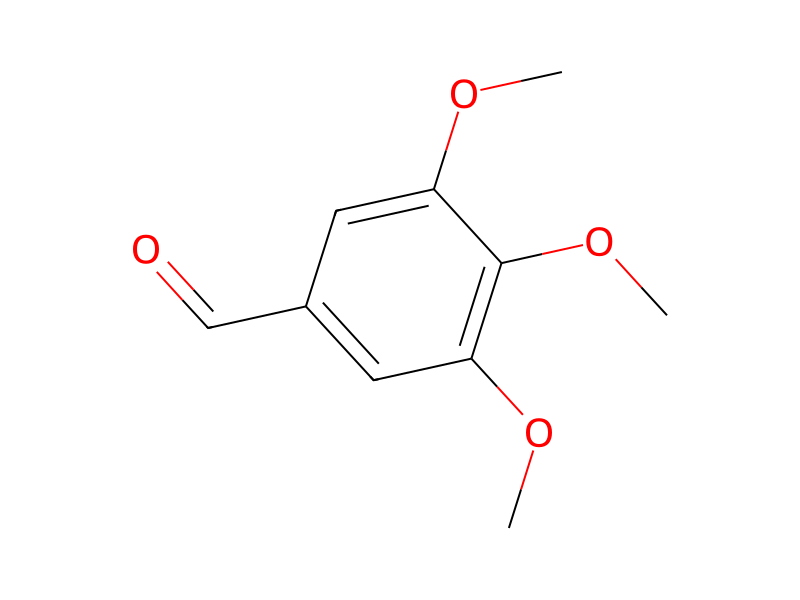
3,4,5-Trimethoxybenzaldehyde → HCID 23001362, compound
Reaction equation

COC1[CH:10]=[C:9](OC)[CH:8]=[C:7]([O:13]C)C=1C=O.C[O:16]C1C=C(OC)C(OC)=CC=1C=O.CO[C:31]1[CH:32]=[C:33]([CH:36]=[C:37](OC)[C:38]=1OC)[CH:34]=O>>[CH:9]1([CH2:8][C:7]([OH:13])=[O:16])[C:32]2[C:33](=[CH:36][CH:37]=[CH:38][CH:31]=2)[CH:34]=[CH:10]1Participants


Procedure
1.19 g (5.0 mmol) of 5,6-difluoro-2-methylindene-3-acetic acid methyl ester is dissolved in 10 ml of dry pyridine followed by 0.98 g (5.0 mmol) of 3,4,5-trimethoxy-benzaldehyde. The flask is placed under nitrogen, and 5.0 g (5.1 mol) of Triton B is added. The deeply colored solution is allowed to stand overnight, and then water (2 ml) is added. After standing for 15 minutes, it is poured into an excess of water. The organics are extracted with ether (2×50 ml). The aqueous phase is added to 10% HCl-ice. The orange, gummy solid that precipitates is extracted into methylene chloride and dried (MgSO4). The solvent is removed to leave an orange solid. The solid is filtered to give a crude product which is recrystallized to give 5,6-difluoro-2-methyl-1-(3,4,5-trimethoxy-benzylidene)-indene-3-acetic acid. When 2,4,6-trimethoxybenzaldehyde or 2,4,5-trimethoxybenzaldehyde is utilized in the above procedure, instead of 3,4,5-trimethoxy-benzaldehyde, the corresponding indene acetic acid is obtained. (R and R1 =H, R2 and R3 =F, R4 =H, R5, R6 and R7 =OCH3, R8 =CH3, R9 =H, R10 and R11 =double bond, m=0, n=0, M=OH)
Sources & evidence
- ORD record
- ord-7b04c1a7af8145c79e733a9913ec572a
- Source dataset
- uspto-grants-2000_09
- Patent number
- US06121321
Reaction notes
Loading…