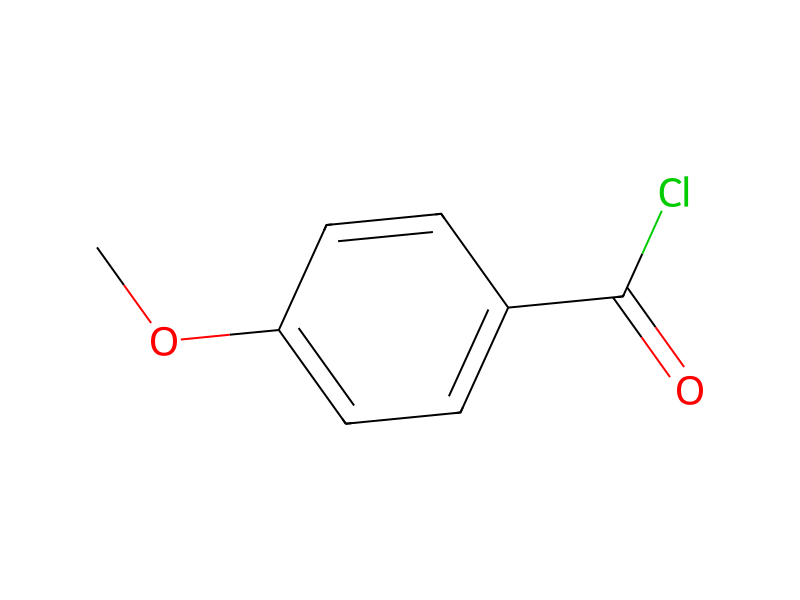
p-Anisoyl chloride → HCID 11470410, compound
Reaction equation

[C:1](Cl)(=[O:10])[C:2]1[CH:7]=[CH:6][C:5]([O:8][CH3:9])=[CH:4][CH:3]=1.[CH:12]([NH:15][CH:16](O)[CH3:17])([CH3:14])[CH3:13].C1C[O:22]CC1>>[CH:12]([N:15]([CH2:16][CH2:17][OH:22])[C:1](=[O:10])[C:2]1[CH:7]=[CH:6][C:5]([O:8][CH3:9])=[CH:4][CH:3]=1)([CH3:14])[CH3:13]Participants



Conditions
- Temperature
- 7 °C
Procedure
Anisoyl chloride (17.1 g, 0.1 mol) in THF (100 mL) was added dropwise to a solution of N-isopropylaminoethanol (41.3 g, 0.4 mol) in THF (200 mL) under magnetic stirring at 4 to 10° C. The reaction mixture was stirred for 2 h at room temperature, and the solvent was evaporated in vacuo. The residue was dissolved in ice-cold water (200 mL), and the solution was neutralized with conc. hydrochloric acid. The emulsion was extracted with ethyl acetate (3' 150 mL). Extracts were washed with saturated aqueous NaCl (3' 50 mL), dried over Na2SO4, and evaporated to a solid. Recrystallization from warm toluene-hexanes gave pure 8 as white crystals (20.5 g, 88%). 1H NMR (CDCl3): 7.32 (2H, d, J=8.6 Hz); 6.89 (2H, d, J=8.6 Hz); 4.40 (1H, br. s); 4.09 (1H, m); 3.80 (3H, s); 3.90-3.70 (1H, m); 3.53 (2H, t, J=4.6 Hz); 1.13 (6H, d, J=6.8 Hz). 13C NMR (CDCl3): 173.56 (C=O); 160.60 (C--OMe); 128.71 [C--C(O)]; 128.16 (Arom. CH); 113.89 (Arom. CH); 63.69 (CH2OH); 55.39 (OCH3); 50.60 (N--CH); 44.45 (N--CH2); 21.19 (C--CH3).
Workup
- stirringThe reaction mixture was stirred for 2 h at room temperature
- customthe solvent was evaporated in vacuo
- dissolutionThe residue was dissolved in ice-cold water (200 mL)
- extractionThe emulsion was extracted with ethyl acetate (3' 150 mL)
- washExtracts were washed with saturated aqueous NaCl (3' 50 mL),
- dry with materialdried over Na2SO4
- customevaporated to a solid
- customRecrystallization
- temperaturefrom warm toluene-hexanes
Sources & evidence
- ORD record
- ord-fe245f3ac5b845ad867241466719334b
- Source dataset
- uspto-grants-2000_09
- Patent number
- US06121437
Reaction notes
Loading…