Ammonia → 6-Aminohexanenitrile
Reaction equation

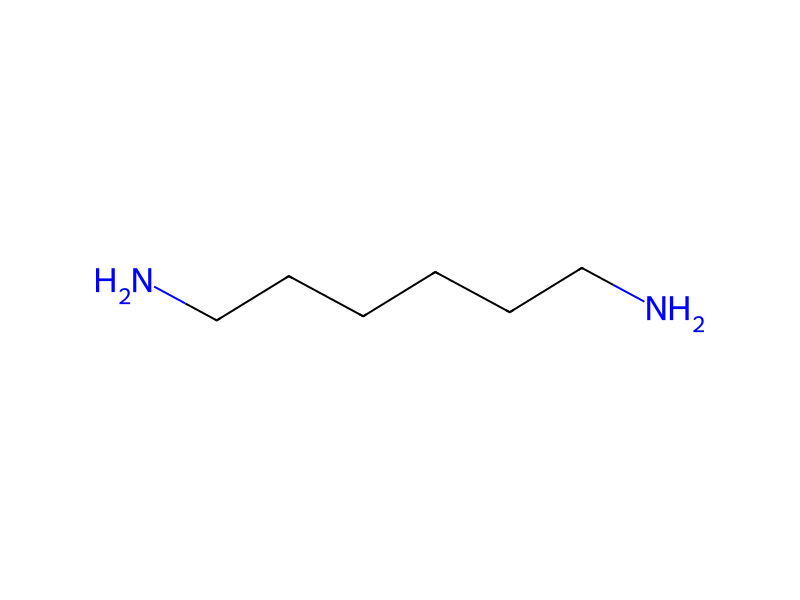
[CH:1]([CH2:3][CH2:4][CH2:5][CH2:6][C:7]#[N:8])=O.[OH-].[Li+].[NH3:11]>[H][H].[Pd]>[NH2:11][CH2:1][CH2:3][CH2:4][CH2:5][CH2:6][C:7]#[N:8].[NH2:11][CH2:1][CH2:3][CH2:4][CH2:5][CH2:6][CH2:7][NH2:8]Participants
7






Conditions
- Temperature
- 100 °C
Procedure
In the autoclave described in Example 1 there were placed 20 g of 5-formylvaleronitrile and 3 g of Pd (2%) on Al2O3 powder and 0.41 g of lithium hydroxide under protective gas (argon). The autoclave was then sealed and 140 ml of NH3 were forced in. The mixture was stirred using a magnetic stirrer and was heated to 100° C. and the overall pressure raised to 80 bar by forcing in hydrogen and then kept at this value by continuous replenishment with hydrogen. After a period of 23 hours the autoclave was depressurized and the hydrogenation effluent analyzed by gas chromatography. The products formed comprised 59.01% of 6-aminocapronitrile and 5.1% of hexamethylene diamine (conversion 100%).
Workup
- customThe autoclave was then sealed
- temperaturethe overall pressure raised to 80 bar
Sources & evidence
- ORD record
- ord-2f3483a361a44544a596ba54b00fbf7b
- Source dataset
- uspto-grants-2000_09
- Patent number
- US06121481
Reaction notes
Loading…