1-Phenethylamine, (-)- → 4-(1-Ethoxycarbonylcyclopropyl)-3-fluoro-1-[1-(S)-phenylethyl1-3-pyrrolin-2-one
Reaction equation
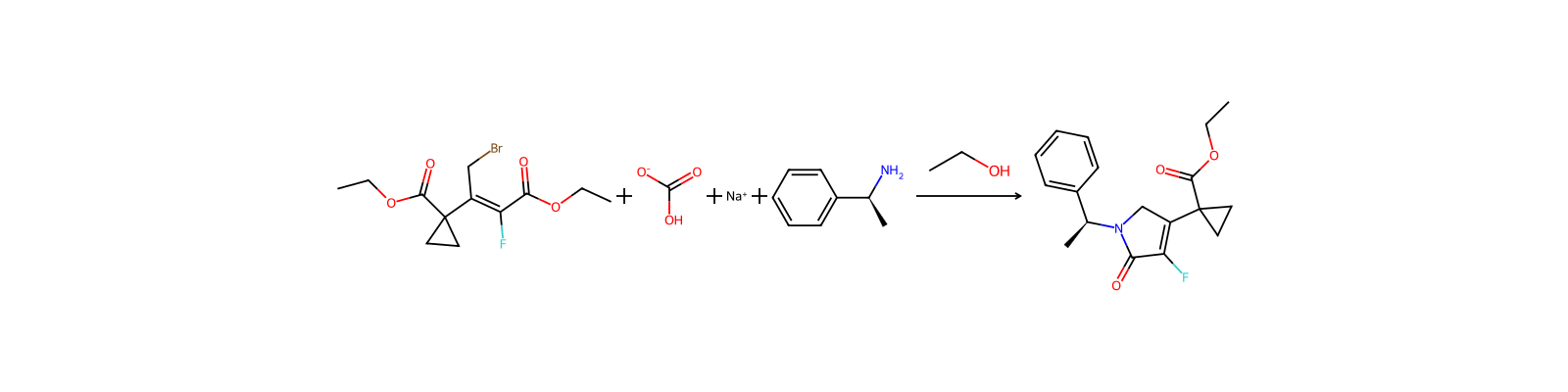
Br[CH2:2]/[C:3](/[C:11]1([C:14]([O:16][CH2:17][CH3:18])=[O:15])[CH2:13][CH2:12]1)=[C:4](/[F:10])\[C:5]([O:7]CC)=O.C(=O)([O-])O.[Na+].[C:24]1([C@@H:30]([NH2:32])[CH3:31])[CH:29]=[CH:28][CH:27]=[CH:26][CH:25]=1>C(O)C>[CH2:17]([O:16][C:14]([C:11]1([C:3]2[CH2:2][N:32]([C@H:30]([C:24]3[CH:29]=[CH:28][CH:27]=[CH:26][CH:25]=3)[CH3:31])[C:5](=[O:7])[C:4]=2[F:10])[CH2:12][CH2:13]1)=[O:15])[CH3:18]Participants
5
Reactant 3



Product 1

Reagents, catalysts & solvents 1

Procedure
To a solution of (E)-ethyl 4-bromo-3-(1-ethoxycarbonylcyclopropyl)-2-fluoro-2-butenoate (143 mmol) in ethanol (1000 ml) was added sodium hydrogencarbonate (30.08 g, 358 mmol). After adding dropwise 1-(S)-phenylethylamine (20.31 ml, 158 mmol) thereinto at room temperature, the mixture was heated under reflux for 3 hours. Then the liquid reaction mixture was cooled and filtered through celite. The filtrate was concentrated under reduced pressure and the residue was subjected to flash silica gel column chromatography (eluent:n-hexane:ethyl acetate=2:1) to obtain 36.95 g (81.2%) of the-title compound as an oily substance.
Workup
- temperatureunder reflux for 3 hours
- customThen the liquid reaction mixture
- temperaturewas cooled
- filtrationfiltered through celite
- concentrationThe filtrate was concentrated under reduced pressure
Sources & evidence
- ORD record
- ord-0469acacdfb745b48ea2fbe4377c0cb1
- Source dataset
- uspto-grants-2000_09
- Patent number
- US06121285
Reaction notes
Loading…