Isatin → 2-(2-Carboxyphenyl)-4-quinolinecarboxylic acid
Reaction equation

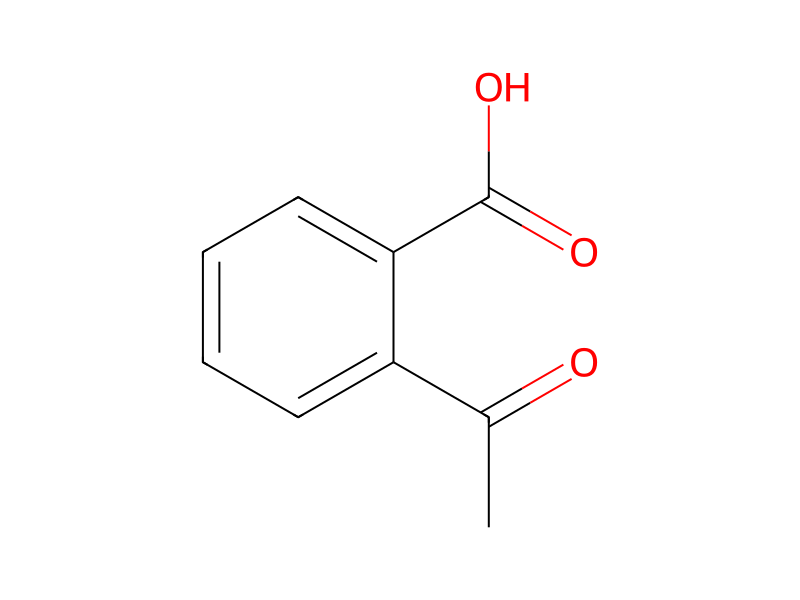
[NH:1]1[C:11]2[C:6](=[CH:7][CH:8]=[CH:9][CH:10]=2)[C:4](=O)[C:2]1=[O:3].[OH-:12].[Na+].[C:14]([C:17]1[CH:25]=[CH:24][CH:23]=[CH:22][C:18]=1[C:19]([OH:21])=[O:20])(=O)[CH3:15]>O>[C:19]([C:18]1[CH:22]=[CH:23][CH:24]=[CH:25][C:17]=1[C:14]1[CH:15]=[C:4]([C:2]([OH:12])=[O:3])[C:6]2[C:11](=[CH:10][CH:9]=[CH:8][CH:7]=2)[N:1]=1)([OH:21])=[O:20]Participants
5
Reactant 3


Product 1

Reagents, catalysts & solvents 1

Conditions
- Temperature
- 90 °C
Procedure
In 15 ml of water were dissolved 14.7 g (0.1 mol) of isatin and 8 g (0.2 mol) of sodium hydroxide. Then, 16.4 g (0.1 mol of 2-acetylbenzoic acid was added thereto and the resulting mixture was heated at 90° C. under reflux. When the reaction became mild, the mixture was heated at 115° C. for an additional 1 hour. After allowing to cool to room temperature, it was poured into 300 g of water cooled with ice. The aqueous layer was washed with ether and acidified with 2M hydrochloric acid. The precipitate thus formed was collected by filtration to thereby give 9.85 g of 2-(2-carboxyphenyl)-4-quinolinecarboxylic acid. NMR (270 MHz, CD3COCD3): δ 7.70-8.70 (m,9H).
Workup
- temperatureunder reflux
- temperaturethe mixture was heated at 115° C. for an additional 1 hour
- temperatureto cool to room temperature
- temperaturecooled with ice
- washThe aqueous layer was washed with ether
- customThe precipitate thus formed
- filtrationwas collected by filtration
Sources & evidence
- ORD record
- ord-8f7a1be3744644c08fc6aedc0da7de6a
- Source dataset
- uspto-grants-1998_07
- Patent number
- US05780634
Reaction notes
Loading…