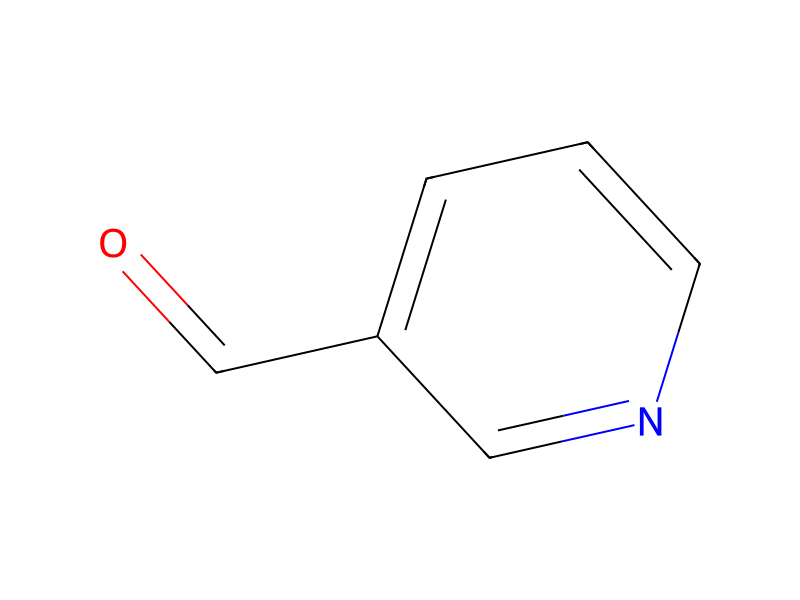
3-Pyridinecarboxaldehyde → HCID 70252295, compound
Reaction equation

[N:1]1[CH:6]=[CH:5][CH:4]=[C:3]([CH:7]=O)[CH:2]=1.[ClH:9].[NH2:10][N:11]1[CH2:15][CH:14]([CH3:16])[N:13]([CH3:17])[C:12]1=[O:18]>CO>[ClH:9].[CH3:17][N:13]1[CH:14]([CH3:16])[CH2:15][N:11]([N:10]=[CH:7][C:3]2[CH:2]=[N:1][CH:6]=[CH:5][CH:4]=2)[C:12]1=[O:18]Participants
Reactant 2

Product 1

Reagents, catalysts & solvents 1

Procedure
2.3 g of pyridine-3-carbaldehyde are added at room temperature to a solution of 3.6 g of 1-amino-3,4-dimethylimidazolidin-2-one hydrochloride in 25 ml of methanol. The solution is concentrated by evaporation and the residue is stirred with tetrahydrofuran. 4.6 g of 3,4-dimethyl-1-(pyridin-3-ylmethyleneamino)-imidazolidin-2-one hydrochloride having a melting point of 232°-236° are obtained. 2.3 g of triethylamine are added to a suspension of 4.4 g of 3,4-dimethyl-1-(pyridin-3-ylmethyleneamino)-imidazolidin-2-one hydrochloride in 100 ml of tetrahydrofuran and after 20 minutes under reflux the reaction mixture is filtered while hot. 300 ml of hexane are added to the filtrate. The crystals that have precipitated are filtered off with suction and dried. 2.5 g of the title compound having a melting point of 126°-129° are obtained.
Workup
- concentrationThe solution is concentrated by evaporation
Sources & evidence
- ORD record
- ord-7ed4c2c703124d73b8a3a0d2b71c45db
- Source dataset
- uspto-grants-1998_07
- Patent number
- US05783704
Reaction notes
Loading…