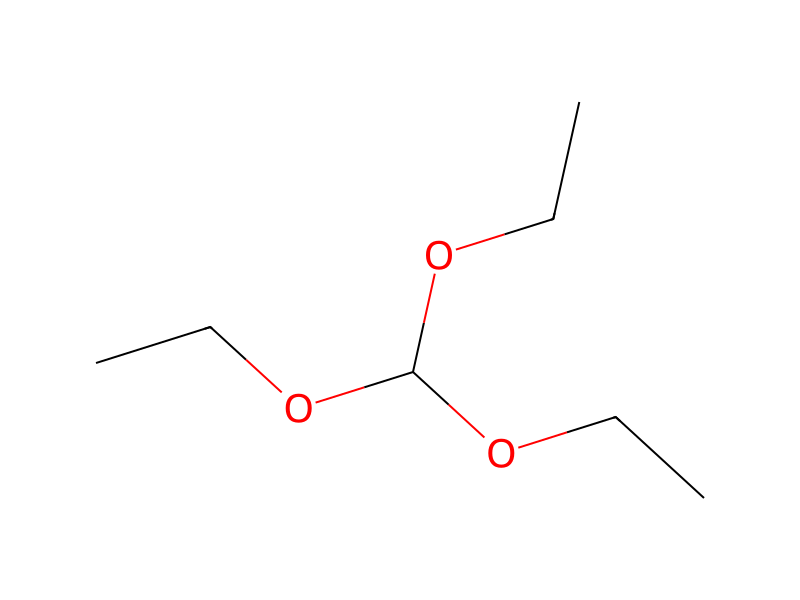
Ethyl orthoformate → 2-Bromo-4-(diethoxymethyl)-1-fluorobenzene
Reaction equation

[Br:1][C:2]1[CH:3]=[C:4]([CH:7]=[CH:8][C:9]=1[F:10])C=O.[CH:11]([O:18][CH2:19][CH3:20])([O:15][CH2:16][CH3:17])OCC.[Br-].[Br-].[Br-].C([N+](CCCC)(CCCC)CCCC)CCC.C([N+](CCCC)(CCCC)CCCC)CCC.C([N+](CCCC)(CCCC)CCCC)CCC.C([O-])(O)=O.[Na+]>C(O)C>[Br:1][C:2]1[CH:3]=[C:4]([CH:11]([O:15][CH2:16][CH3:17])[O:18][CH2:19][CH3:20])[CH:7]=[CH:8][C:9]=1[F:10]Participants
6





Procedure
A 10 mL vial equipped with stir bar was charged with 1 g of 3-bromo-4-fluoro-benzaldehyde, 2 mL of triethyl orthoformate, and 5 mL of anhydrous ethanol. 50 mgs of tetrabutylammonium tribromide was then added, and the reaction mixture was stirred at ambient temperature overnight. TLC shows complete conversion to slightly less polar product. The crude reaction is poured into NaHCO3, and extracted with ethyl acetate (2×25 mL). Combined organics are dried over MgSO4, and filtered over a pad of silica. The solvents are reduced under vacuum and a colorless oil (1 g) is isolated. The diethyl acetal intermediate is used as such in the next step. 74% yield.
Workup
- customA 10 mL vial equipped
- stirringthe reaction mixture was stirred at ambient temperature overnight
- customThe crude reaction
- extractionextracted with ethyl acetate (2×25 mL)
- dry with materialCombined organics are dried over MgSO4
- filtrationfiltered over a pad of silica
Sources & evidence
- ORD record
- ord-013c0ceea38b46ebb4121fc655bdeda2
- Source dataset
- uspto-grants-2013_04
- Patent number
- US08415310B2
Reaction notes
Loading…