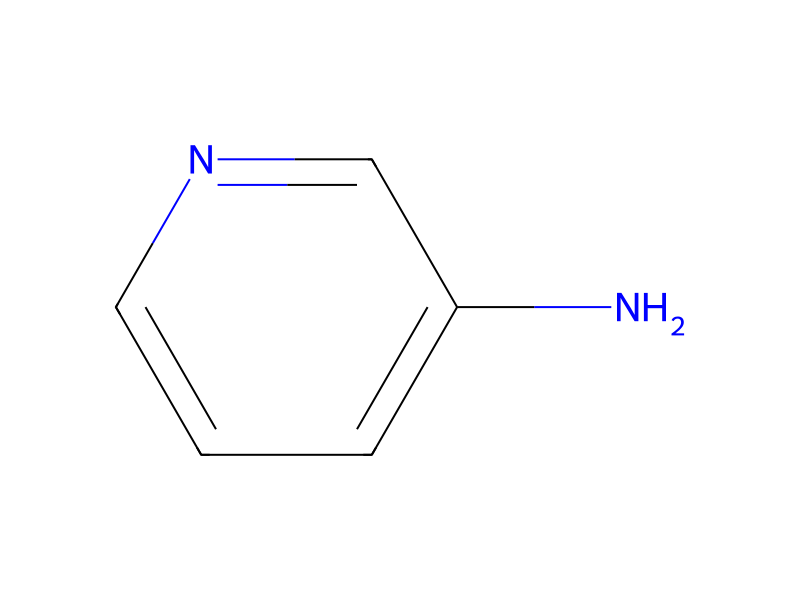
3-Aminopyridine → HCID 44600698, compound
Reaction equation

[C:1]([C:4]1[C:13]2[C:8](=[CH:9][CH:10]=[CH:11][CH:12]=2)[C:7](=[O:14])[O:6][C:5]=1[NH:15][C@H:16]([C:19]1[CH:24]=[CH:23][CH:22]=[CH:21][CH:20]=1)[CH2:17][CH3:18])(=O)[CH3:2].[NH2:25][C:26]1[CH:27]=[N:28][CH:29]=[CH:30][CH:31]=1>C(#N)C>[C:19]1([C@@H:16]([NH:15][C:5]([C:4]2[C:13]3[C:8](=[CH:9][CH:10]=[CH:11][CH:12]=3)[C:7](=[O:14])[N:25]([C:26]3[CH:27]=[N:28][CH:29]=[CH:30][CH:31]=3)[C:1]=2[CH3:2])=[O:6])[CH2:17][CH3:18])[CH:20]=[CH:21][CH:22]=[CH:23][CH:24]=1Participants
Reactant 2

Product 1

Reagents, catalysts & solvents 1

Conditions
- Temperature
- 170 °C
Procedure
A mixture of 4-acetyl-3-((S)-1-phenyl-propylamino)-isochromen-1-one (100 mg) and 3-aminopyridine (400 mg, excess) in acetonitrile (0.2 mL) was heated under microwave irradiation at 170° C. for 15 min. The reaction mixture was partitioned between water (20 ml) and ethyl acetate (20 ml), and the organic phase was washed with water (3×10 ml). The product was extracted into aqueous phase with aq. 2M HCl (10 ml), the aqueous solution was neutralised with aq. 10% Na2CO3 and extracted again with ethyl acetate and evaporated. The obtained residue was purified by flash chromatography on SiO2 (5 g, gradient heptane-ethyl acetate, the product came out with 100% ethyl acetate) to give 37 mg of oil, which was precipitated from methanol (0.1 mL) and water (10 mL) with sonication for 10 min. The title compound was separated by filtration to give 10 mg of brown solid. LC-MS (m/z) 398.1 (MH+); tR=1.06. 1H NMR (250 MHz, 70° C., DMSO-d6): 0.93 (t, J=7.4 Hz, 3H, Me of Et), 1.72-1.88 (overlapping m, CH2 of Et), 1.85 (overlapping s, 3H, Me), 4.97 (q (dt), J=8 Hz, J=6.9 Hz, 1H, CHNH), 7.23 (m, 1H), 7.28-7.42 (m, 5H), 7.49 (t, J=7.6 Hz, 1H), 7.59 (dd, J=4.8 Hz, J=8.1 Hz, 1H), 7.69 (t, J=7.7 Hz, 1H), 7.76 (d of dd, J=8.1 Hz, J=2.4 Hz, J=1.4 Hz, 1H), 8.21 (dd, J=8 Hz, J=0.8 Hz, 1H), 8.49 (d, J=2.4 Hz), 8.67 (dd, J=4.7 Hz, J=2.4 Hz, 1H), 8.72 (br d, J=8.2 Hz, NHCO).
Workup
- customThe reaction mixture was partitioned between water (20 ml) and ethyl acetate (20 ml)
- washthe organic phase was washed with water (3×10 ml)
- extractionThe product was extracted into aqueous phase with aq. 2M HCl (10 ml)
- extractionextracted again with ethyl acetate
- customevaporated
- customThe obtained residue was purified by flash chromatography on SiO2 (5 g, gradient heptane-ethyl acetate
Sources & evidence
- ORD record
- ord-f257607fdf7341578c6a8baf57e0be38
- Source dataset
- uspto-grants-2013_04
- Patent number
- US08415356B2
Reaction notes
Loading…