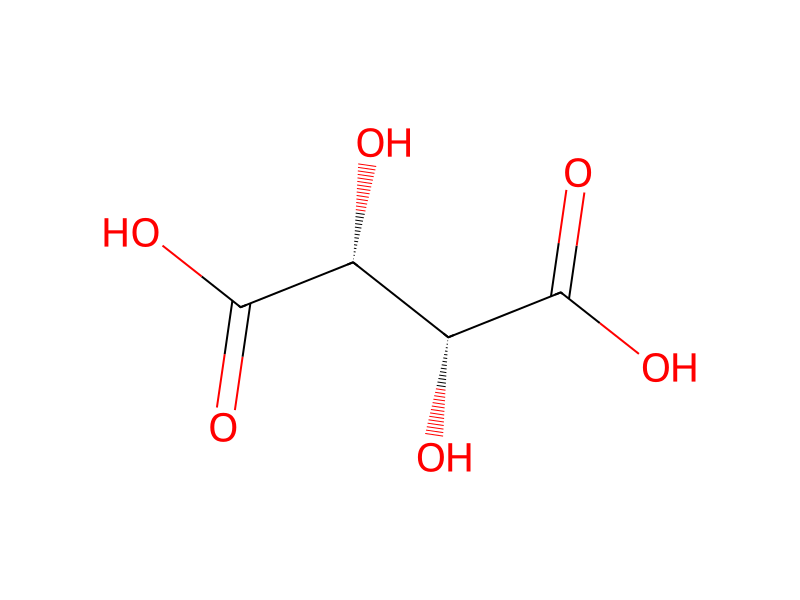
L-Tartaric acid → Tartrate
Reaction equation

[CH3:1][N:2]1[CH2:11][C@@H:10]([C:12]2[CH:21]=[CH:20][C:19]3[C:14](=[CH:15][CH:16]=[CH:17][CH:18]=3)[CH:13]=2)[C:9]2[C:4](=[CH:5][C:6]([C:22]3[N:27]=[N:26][C:25]([NH2:28])=[CH:24][CH:23]=3)=[CH:7][CH:8]=2)[CH2:3]1.[C:29]([OH:38])(=[O:37])[C@@H:30]([C@H:32]([C:34]([OH:36])=[O:35])[OH:33])[OH:31]>CO.O>[C:34]([C@@H:32]([C@H:30]([C:29]([O-:38])=[O:37])[OH:31])[OH:33])([O-:36])=[O:35].[CH3:1][N:2]1[CH2:11][C@@H:10]([C:12]2[CH:21]=[CH:20][C:19]3[C:14](=[CH:15][CH:16]=[CH:17][CH:18]=3)[CH:13]=2)[C:9]2[C:4](=[CH:5][C:6]([C:22]3[N:27]=[N:26][C:25]([NH2:28])=[CH:24][CH:23]=3)=[CH:7][CH:8]=2)[CH2:3]1Participants
Reactant 2

Product 2

Reagents, catalysts & solvents 2


Conditions
- Temperature
- 0 °C
Procedure
Alternative procedure: To a slurry of Compound 2, free base (1.5 g, 4.1 mmol) in methanol (80 mL) was added a solution of L-tartaric acid (0.63 g, 4.2 mmol) in methanol (15 mL) and water (10 mL). The reaction slurry became a clear solution after heating under reflux. The resulting solution was then cooled to 0° C. while stirring and precipitation occurred. The precipitate obtained was collected by filtration. This solid was re-crystallized twice from methanol (150 mL) and water (20 mL). The resulting solid was dissolved in methanol (25 mL) and water (100 mL), and the solution was lyophilized to give the L-tartrate salt of Compound 2, (1.4 g, 65%, AUC HPLC>99%) as a white solid: [α]23D +79.1° (c 0.15, methanol); 1H NMR (500 MHz, CDCl3) δ 7.87-7.80 (m, 6H), 7.69 (dd, J=8.0, 1.5 Hz, 1H), 7.51-7.48 (m, 2H), 7.30 (dd, J=8.5, 1.5 Hz, 1H), 7.04-7.01 (m, 2H), 4.71 (dd, J=11.0, 5.5 Hz, 1H), 4.43 (s, 2H), 4.39 (d, J=16.0 Hz, 1H), 4.29 (d, J=15.5 Hz, 1H), 3.64(dd, J=11.5, 5.5 Hz, 1H), 3.37-3.30 (m, 1H), 2.85 (s, 3H); ESI MS m/z 367 [M+H]+.
Workup
- temperatureafter heating
- temperatureunder reflux
- customprecipitation
- customThe precipitate obtained
- filtrationwas collected by filtration
- customThis solid was re-crystallized twice from methanol (150 mL) and water (20 mL)
- dissolutionThe resulting solid was dissolved in methanol (25 mL)
Sources & evidence
- ORD record
- ord-d8d6974658384fed89e11c91e7bdafb2
- Source dataset
- uspto-grants-2013_04
- Patent number
- US08420811B2
Reaction notes
Loading…