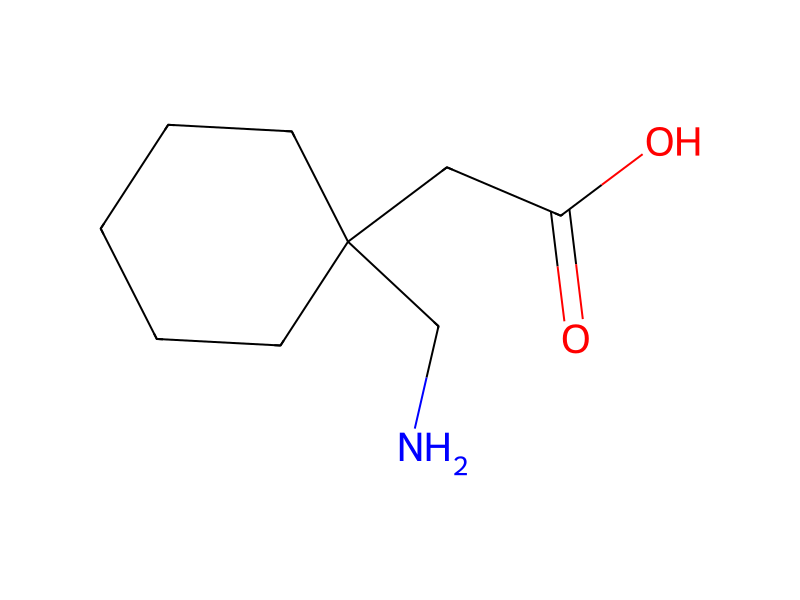
Sodium Carbonate → Gabapentin
Reaction equation

[CH2:1]1[CH2:6][CH2:5][C:4]([CH2:11][NH2:12])([CH2:7][C:8]([OH:10])=[O:9])[CH2:3][CH2:2]1.Cl.C(=O)([O-])[O-].[Na+].[Na+]>C(O)C1C=CC=CC=1>[CH2:1]1[CH2:2][CH2:3][C:4]([CH2:11][NH2:12])([CH2:7][C:8]([OH:10])=[O:9])[CH2:5][CH2:6]1Participants
Reactant 2


Product 1
Reagents, catalysts & solvents 1

Conditions
- Temperature
- 2.5 °C
Procedure
Gabapentin hydrochloride (50 g, 0.24 mol) was dissolved in benzyl alcohol (335 ml) at room temperature. Finely powdered sodium carbonate (25.4 g, 0.23 mol) was added, and the reaction mixture was stirred until the solution pH reaches 7.0 to 7.5. It will take about 2 to 3 hours. The suspension was filtered and the residue washed with about 15 ml benzyl alcohol. The clear filtrate was cooled to 0-5° C. and 700 ml of methyl tert.butyl ether (MTBE) was added. The solution was stirred for one hour and the precipitated gabapentin filtered. The crude gabapentin was washed with MTBE and stirred in ethanol to remove traces of benzyl alcohol to obtain pure gabapentin. Yield: 36.7 g (90%), HPLC: 99.7%, chloride content: 22 ppm, lactam content: 0.01%.
Workup
- filtrationThe suspension was filtered
- washthe residue washed with about 15 ml benzyl alcohol
- addition700 ml of methyl tert.butyl ether (MTBE) was added
- stirringThe solution was stirred for one hour
- filtrationthe precipitated gabapentin filtered
- washThe crude gabapentin was washed with MTBE
- stirringstirred in ethanol
- customto remove traces of benzyl alcohol
Sources & evidence
- ORD record
- ord-3128fe8372fc4a4e937ec8dbcef612ba
- Source dataset
- uspto-grants-2013_04
- Patent number
- US08431739B2
Reaction notes
Loading…