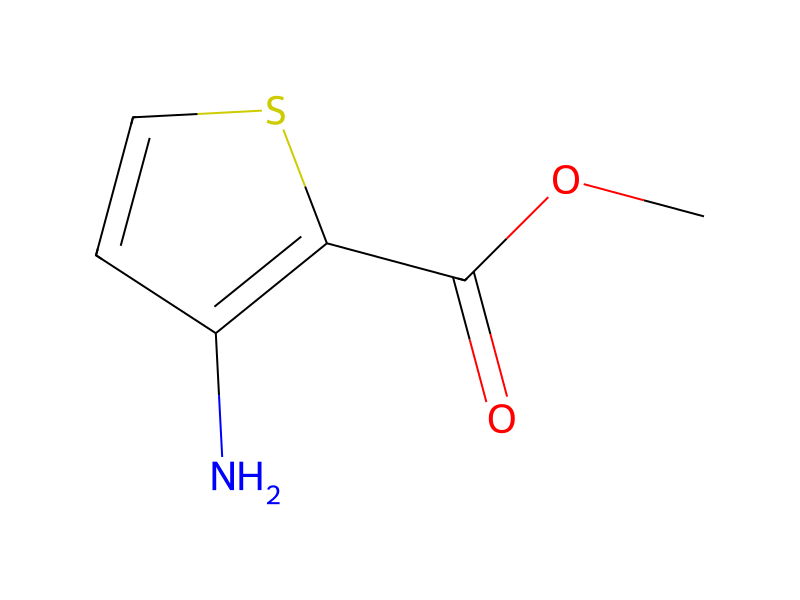
Methyl 3-amino-2-thiophenecarboxylate → Thieno(3,2-d)pyrimidine-2,4(1H,3H)-dione
Reaction equation

ClC1N=C(N2CCOCC2)C2SC=CC=2N=1.[NH2:17][C:18]1[CH:22]=[CH:21][S:20][C:19]=1[C:23]([O:25]C)=O.[O-:27][C:28]#[N:29].[K+]>C(O)(=O)C.O>[NH:17]1[C:18]2[CH:22]=[CH:21][S:20][C:19]=2[C:23](=[O:25])[NH:29][C:28]1=[O:27]Participants
6




Procedure
Scheme 1 shows the synthesis of 4-(2-chlorothieno[3,2-d]pyrimidin-4-yl)morpholine 4 starting by cyclization of methyl 3-amino-thiophenecarboxylate 1 and potassium cyanate in acetic acid and water at room temperature to give thieno[3,2-d]pyrimidine-2,4(1H,3H)-dione 2. This is an improvement over cyclization of 1 with urea which requires high temperature and evolution of ammonia gas. Thieno[3,2-d]pyrimidine-2,4(1H,3H)-dione 2 was converted to 2,4-dichlorothieno[3,2-d]pyrimidine 3 with phosphorous oxychloride and a catalytic amount of N,N-dimethylaniline (0.75 equiv.) in acetonitrile. Selective substitution at the 4-position with morpholine gave 4.
Sources & evidence
- ORD record
- ord-100e9b5d332148f29ac20a7646bbe1b6
- Source dataset
- uspto-grants-2013_04
- Patent number
- US08431694B1
Reaction notes
Loading…