Diisopropylethylamine → HCID 87058997, compound
Reaction equation

Br[C:2]1[CH:7]=[CH:6][C:5]([C:8]([OH:17])([C:13]([F:16])([F:15])[F:14])[C:9]([F:12])([F:11])[F:10])=[CH:4][CH:3]=1.[CH3:18][C@@H:19]1[NH:24][CH2:23][CH2:22][N:21](C(OC(C)(C)C)=[O:26])[CH2:20]1.CC(C)([O-])C.[Na+].C1(P(C2CCCCC2)C2C=CC=CC=2C2C(OC(C)C)=CC=CC=2OC(C)C)CCCCC1.CCN(C(C)C)C(C)C.[S:80]1[CH:84]=[CH:83][N:82]=[C:81]1[S:85](Cl)(=[O:87])=[O:86]>C1C=CC(/C=C/C(/C=C/C2C=CC=CC=2)=O)=CC=1.C1C=CC(/C=C/C(/C=C/C2C=CC=CC=2)=O)=CC=1.C1C=CC(/C=C/C(/C=C/C2C=CC=CC=2)=O)=CC=1.[Pd].[Pd].C1(C)C=CC=CC=1>[F:14][C:13]([F:16])([F:15])[C:8]([OH:17])=[O:26].[F:10][C:9]([F:12])([F:11])[C:8]([C:5]1[CH:6]=[CH:7][C:2]([N:24]2[CH2:23][CH2:22][N:21]([S:85]([C:81]3[S:80][CH:84]=[CH:83][N:82]=3)(=[O:87])=[O:86])[CH2:20][C@@H:19]2[CH3:18])=[CH:3][CH:4]=1)([OH:17])[C:13]([F:16])([F:15])[F:14]Participants
Reactant 6





Product 1

Reagents, catalysts & solvents 2


Conditions
- Temperature
- 100 °C
Procedure
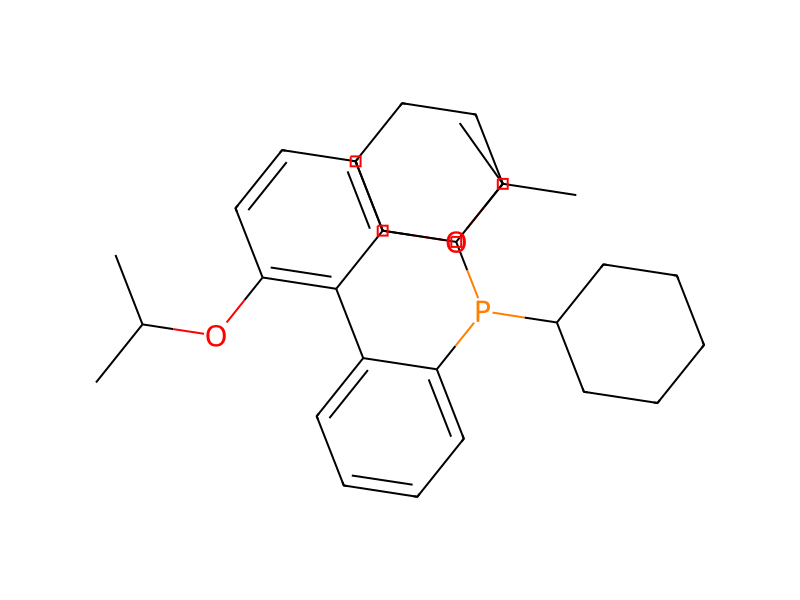
A vial was charged with 2-(4-bromophenyl)-1,1,1,3,3,3-hexafluoro-2-propanol (0.161 g, 0.499 mmol, Bioorg. Med. Chem. Lett. 2002, 12, 3009), (S)-tert-butyl 3-methylpiperazine-1-carboxylate (0.100 g, 0.499 mmol, Sigma-Aldrich, St. Louis, Mo.), sodium tert-butoxide (0.115 g, 1.198 mmol), and 2.5 mL of anhydrous toluene. To this was added dicyclohexyl(2′,6′-diisopropoxybiphenyl-2-yl)phosphine (RuPhos) (0.035 g, 0.075 mmol, Strem Chemical Inc, Newburyport, Mass.) and tris(dibenzylideneacetone)dipalladium (0) (0.023 g, 0.025 mmol, Strem Chemical Inc, Newburyport, Mass.). The vial was sealed and the mixture was heated at 100° C. for 18 h. After that time, the reaction was partitioned between saturated NaHCO3 (50 mL) and EtOAc (50 mL). The organics were separated, washed with brine (50 mL), and dried (NaSO4) and volatiles were removed in vacuo. The residue was dissolved in 2 mL of CH2Cl2. To this was added 4 N HCl in dioxane (5 mL) and the mixture was stirred at room temperature for 3 h. The reaction mixture was concentrated and the residue was dissolved with CH2Cl2 (10 mL). To this was added 1 mL of Hünig's base and 2-thiazolesulfonyl chloride (95 mg, 0.52 mmol, Bioorg. Med. Chem., 2006, 14, 6628). This mixture was stirred at room temperature for 18 h and then concentrated, the residue was dissolved in methanol (3 mL), and filtered through a 0.45 micron filter. The crude material was purified by reverse-phase preparative HPLC using a Phenomenex Gemini C18 column (10 μm), 150×30 mm, eluting with a 0.1% TFA in CH3CN/H2O, gradient (10% to 90% over 20 min) to afford 1,1,1,3,3,3-hexafluoro-2-(4-((2S)-2-methyl-4-(1,3-thiazol-2-ylsulfonyl)-1-piperazinyl)phenyl)-2-propanol trifluoroacetate (41 mg) as an orange oil. 1H NMR (300 MHz, MeOH) δ 8.06 (d, J=3.1 Hz, 1H), 7.98 (d, J=2.9 Hz, 1H), 7.56 (d, J=8.8 Hz, 2H), 6.98 (d, J=8.8 Hz, 2H), 4.17 (d, J=3.4 Hz, 1H), 3.83 (s, 1H), 3.64 (d, J=12.1 Hz, 1H), 3.47 (d, J=2.9 Hz, 1H), 3.07-3.27 (m, 2H), 2.87-3.04 (m, 1H), 2.15 (s, 3H). m/z (ESI, +ve ion) 490.1 (M+H)+. GK-GKRP EC50 (NADPH-coupled)=0.561 μM; GK-GKRP EC50 (LC MS/MS)=0.702 μM.
Workup
- customThe vial was sealed
- customAfter that time, the reaction was partitioned between saturated NaHCO3 (50 mL) and EtOAc (50 mL)
- customThe organics were separated
- washwashed with brine (50 mL)
- dry with materialdried (NaSO4) and volatiles
- customwere removed in vacuo
- dissolutionThe residue was dissolved in 2 mL of CH2Cl2
- additionTo this was added 4 N HCl in dioxane (5 mL)
- concentrationThe reaction mixture was concentrated
- dissolutionthe residue was dissolved with CH2Cl2 (10 mL)
- stirringThis mixture was stirred at room temperature for 18 h
- concentrationconcentrated
- dissolutionthe residue was dissolved in methanol (3 mL)
- filtrationfiltered through a 0.45 micron
- filtrationfilter
- customThe crude material was purified by reverse-phase preparative HPLC
- washeluting with a 0.1% TFA in CH3CN/H2O, gradient (10% to 90% over 20 min)
Sources & evidence
- ORD record
- ord-3b249847cfe34220b0ee6bc77e226061
- Source dataset
- uspto-grants-2013_04
- Patent number
- US08431563B2
Reaction notes
Loading…