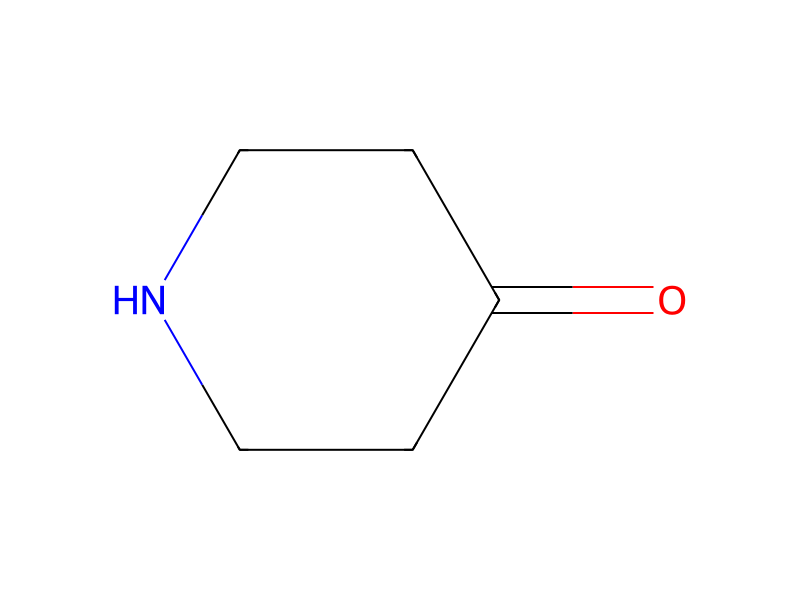
4-Piperidone → HCID 21492266, compound
Reaction equation

F[C:2]1[CH:7]=[CH:6][C:5]([CH2:8][C:9]#[N:10])=[CH:4][CH:3]=1.[O:11]=[C:12]1[CH2:17][CH2:16][NH:15][CH2:14][CH2:13]1>>[O:11]=[C:12]1[CH2:17][CH2:16][N:15]([C:2]2[CH:7]=[CH:6][C:5]([CH2:8][C:9]#[N:10])=[CH:4][CH:3]=2)[CH2:14][CH2:13]1Participants


Procedure
Moreover, the 4-fluoro-phenyl-acetonitrile can be reacted with 4-oxo-piperidine, to yield the 4-(4-oxo-piperidino)-phenyl-acetonitrile, which can be hydrolyzed to the free acid and the acid esterified, or the ethyl α-(3-chloro-4-aminophenyl)-propionate reacted with 4-oxo-2,5-heptadienedioic acid diethyl ester, saponifying and decarboxylating the reaction product, to yield the α-[3-chloro-4-(4-oxo-piperidino)-phenyl]-propionic acid. In corresponding esters, the carbonyl group can be reduced with one equivalent of Grignard compounds, e.g. methyl-, ethyl-, n-propyl-, phenyl- or 4-chlorophenyl-magnesium bromide, to yield, inter alia, the ethyl 4-[4-hydroxy-4-(methyl, ethyl, n-propyl, phenyl or 4-chlorophenyl)-piperidino]-phenyl acetate or α-[3-chloro-4-(4-hydroxy-4-methylpiperidino)-phenyl]-propionate. Said esters or the corresponding acids can be dehydrated wtih sulfuric or phosphoric acid, to yield, for example, the 4-(3-n-propyl-pent-2-enyleneimino)-phenylacetic acid or the α-[3-chloro-4-(3-methylpent-2-enyleneimino)-phenyl]-phenyl]-propionic acid.
Sources & evidence
- ORD record
- ord-91761b72421b47bb88493bf069dbcd4a
- Source dataset
- uspto-grants-1976_12
- Patent number
- US03997669
Reaction notes
Loading…