Sodium Hydroxide → 1-(1-Methyl-2-piperidylidene)-3-(4-trifluoromethylphenyl)urea
Reaction equation

[NH:1]=[C:2]1[CH2:7][CH2:6][CH2:5][CH2:4][N:3]1[CH3:8].[OH-].[Na+].[F:11][C:12]([F:23])([F:22])[C:13]1[CH:18]=[CH:17][C:16]([N:19]=[C:20]=[O:21])=[CH:15][CH:14]=1>O>[CH3:8][N:3]1[CH2:4][CH2:5][CH2:6][CH2:7][C:2]1=[N:1][C:20]([NH:19][C:16]1[CH:15]=[CH:14][C:13]([C:12]([F:11])([F:22])[F:23])=[CH:18][CH:17]=1)=[O:21]Participants
Reactant 3

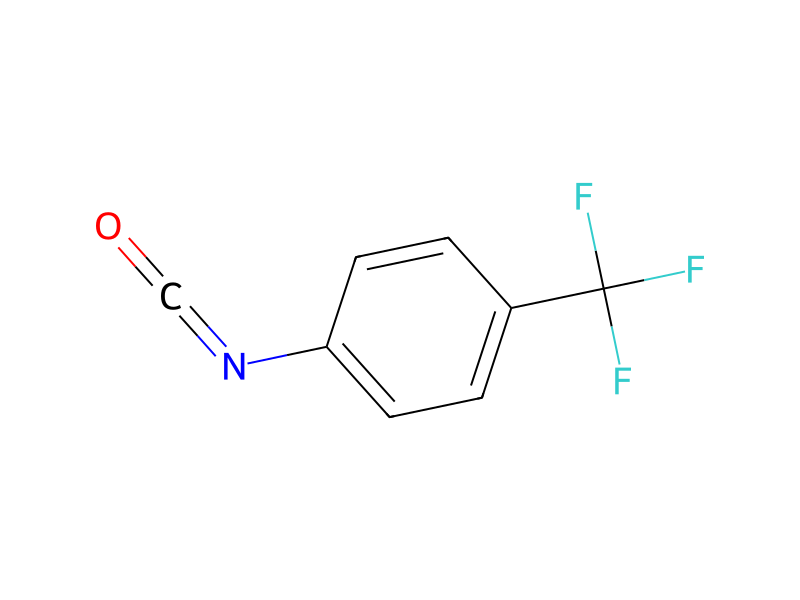

Product 1

Reagents, catalysts & solvents 1

Procedure
The hydrochloride salt of 2-imino-1 -methylpiperidine (7.60 g.; 0.068 mole) is converted to free base by adding 7 ml. of NaOH (50%) to an aqueous slurry (using a minimal amount of water) of the salt and then extracting with benzene. After drying over K 2 CO 3, the benzene solution is filtered through diatomaceous earth. A benzene solution of 12.73 g. (0.068 mole) of p-trifluoromethylphenylisocyanate [prepared according to Inukai and Maki, Kogyo Kagaku Zasshi, 67 (5) 807-9 (1964[ is added to the above solution slowly. After 4 hours of stirring at room temperature, the benzene is evaporated in vacuo to give a solid residue. Repeated recrystallizations of the solid from methanol yields the pure product, 1-(1 -methyl-2 -piperidylidene)-3-(4-trifluoromethylphenyl)urea, m.p. = 154 -155° C.
Workup
- additionby adding 7 ml
- extractionextracting with benzene
- dry with materialAfter drying over K 2 CO 3
- filtrationthe benzene solution is filtered through diatomaceous earth
- additionis added to the above solution slowly
- customthe benzene is evaporated in vacuo
- customto give a solid residue
- customrecrystallizations of the solid from methanol
Sources & evidence
- ORD record
- ord-5e1c00514d9c49e095df92622460ecad
- Source dataset
- uspto-grants-1976_12
- Patent number
- US03998958
Reaction notes
Loading…