Isopropanol → HCID 135964999, compound
Reaction equation

[OH:1][C:2]1[CH:3]=[C:4]([CH:7]=[C:8]([N+:11]([O-:13])=[O:12])[C:9]=1[OH:10])[CH:5]=O.[N:14]1[CH:19]=[CH:18][C:17]([CH3:20])=[CH:16][CH:15]=1.C(O)(C)C>C(OC(=O)C)(=O)C>[N+:11]([C:8]1[CH:7]=[C:4]([CH:5]=[CH:20][C:17]2[CH:18]=[CH:19][N:14]=[CH:15][CH:16]=2)[CH:3]=[C:2]([OH:1])[C:9]=1[OH:10])([O-:13])=[O:12]Participants
5
Reactant 3


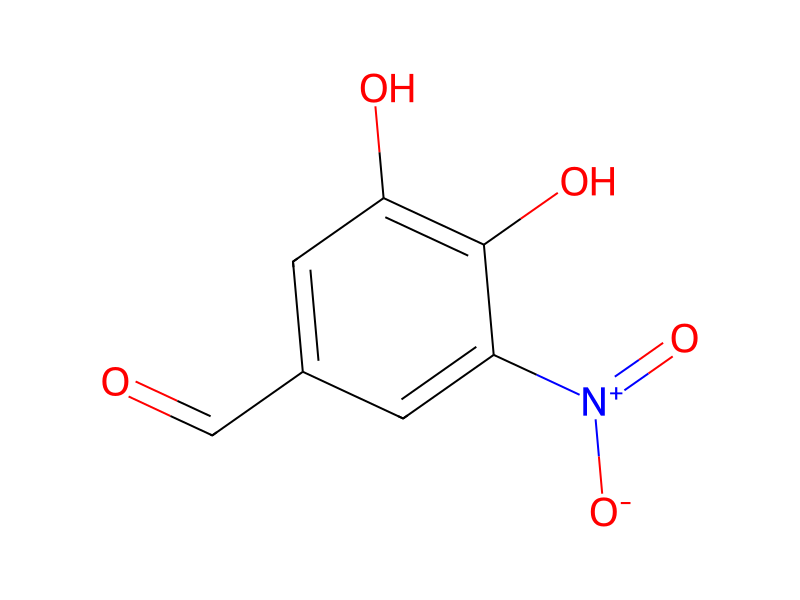
Product 1

Reagents, catalysts & solvents 1

Procedure
A solution containing 2.0 g (0.011 mole) of 3,4-dihydroxy-5-nitrobenzaldehyde and 2.23 g (0.024 mole) of 4-picoline in 9.0 ml of acetic anhydride was refluxed for 1 h. About 15 ml of isopropanol was then added and the solution was cooled to 0° C. where upon the diacetyl-derivative of the desired product crystallized. After filtration the product was suspended in 100 ml of 0.5N hydrochloric acid and refluxed for 1.5 h. After cooling the precipitate was filtered, washed with water and acetone and dried. Yield 1.89 g (67%), m.p. above 350° C.
Workup
- temperaturewas refluxed for 1 h
Sources & evidence
- ORD record
- ord-277b1c50519e4fd5a1b42f8ef1fdadc8
- Source dataset
- uspto-grants-1994_02
- Patent number
- US05283352
Reaction notes
Loading…