Acrylic Acid → 2-Tetrahydrofuranyl acrylate
Reaction equation

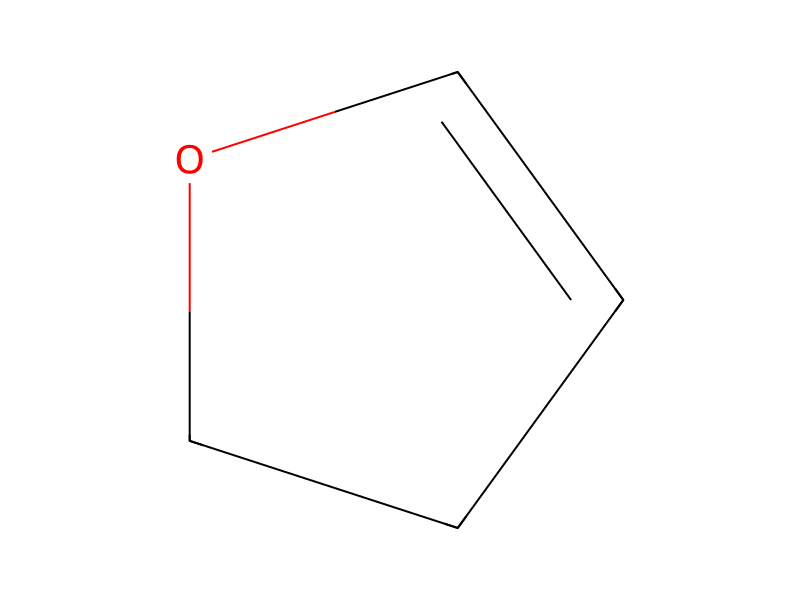
[O:1]1[CH:5]=[CH:4][CH2:3][CH2:2]1.C1C2NC3C(=CC=CC=3)SC=2C=CC=1.[C:20]([OH:24])(=[O:23])[CH:21]=[CH2:22].C=CC1C=CN=CC=1.Cl>>[C:20]([O:24][CH:5]1[CH2:4][CH2:3][CH2:2][O:1]1)(=[O:23])[CH:21]=[CH2:22]Participants




Procedure
To a 100 mL 3-neck round bottom flask equipped with a stir bar, condenser, and addition funnel was added 39 mL of dihydrofuran (FW 70.09, d=0.927), and 0.18 g of phenothiazine. Acrylic acid (19 mL, FW 72.06, d=1.05) was added dropwise slowly with stirring. A mild exotherm (55° C.) occurred. After cooling to room temperature, 0.415 g of poly(4-vinylpyridine hydrochloride) was added and the reaction was stirred overnight. The acid catalyst was then filtered off and 0.2 g each of calcium hydride and potassium carbonate was added to the filtrate. After removal of excess dihydrofuran on a rotovap, 10 mg of DPPH (2,2-diphenyl-1-picrylhydrazyl hydrate) was added and the slurry was vacuum distilled at 200 mtorr at 26° C. to give 26.0 g of 2-tetrahydrofuranyl acrylate.
Workup
- customTo a 100 mL 3-neck round bottom flask equipped with a stir bar, condenser, and addition funnel
- customA mild exotherm (55° C.)
- stirringthe reaction was stirred overnight
- filtrationThe acid catalyst was then filtered off
- addition0.2 g each of calcium hydride and potassium carbonate was added to the filtrate
- customAfter removal of excess dihydrofuran on a rotovap, 10 mg of DPPH (2,2-diphenyl-1-picrylhydrazyl hydrate)
- additionwas added
- distillationdistilled at 200 mtorr at 26° C.
Sources & evidence
- ORD record
- ord-4cbf9a29fdef4c8bae1a5693f707c402
- Source dataset
- uspto-grants-1994_02
- Patent number
- US05286595
Reaction notes
Loading…