Sulfuric Acid → Quinacridone
Reaction equation

[CH2:1]1[C:6]2[NH:7][C:8]3[C:13]([C:14](=[O:15])[C:5]=2[CH2:4][C:3]2[NH:16][C:17]4[C:22]([C:23](=[O:24])[C:2]1=2)=[CH:21][CH:20]=[CH:19][CH:18]=4)=[CH:12][CH:11]=[CH:10][CH:9]=3.[OH-].[K+].S(=O)(=O)(O)O>CS(C)=O>[CH:20]1[CH:21]=[C:22]2[C:23]([C:2]3[C:3]([NH:16][C:17]2=[CH:18][CH:19]=1)=[CH:4][C:5]1[C:14]([C:13]2[C:8]([NH:7][C:6]=1[CH:1]=3)=[CH:9][CH:10]=[CH:11][CH:12]=2)=[O:15])=[O:24]Participants
Reactant 3



Product 1
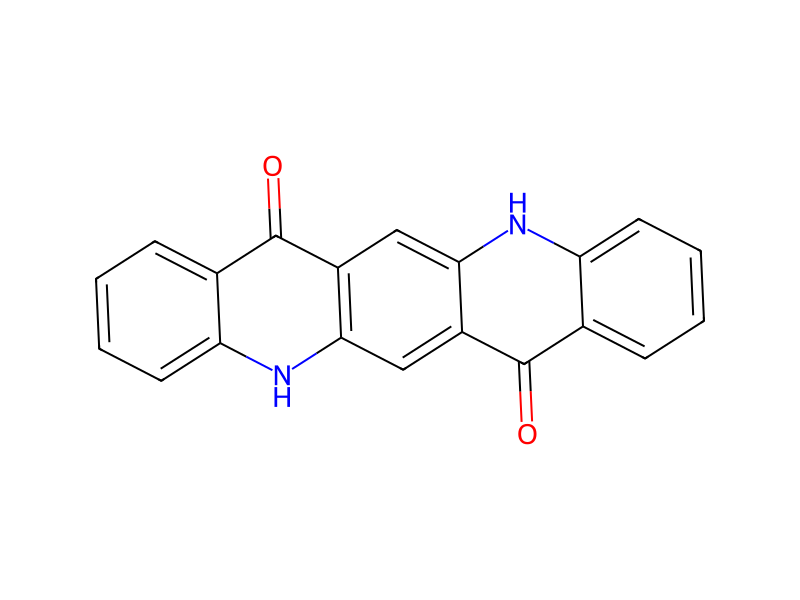
Reagents, catalysts & solvents 1

Procedure
The oxidation of 6,13-dihydroquinacridone is carried out as described in the Japanese Patent Disclosure JP 54-135821, Example 5. Thus, 10 grams 6,13-dihydroquinacridone are stirred into a mixture of 100 ml dimethyl sulfoxide and 20 grams 33% aqueous potassium hydroxide solution at 110° to 120° and air is then introduced into the vessel at a rate of 90-96 ml/min. for a period of 5 hours. The reaction mixture is cooled and 33% aqueous sulfuric acid is introduced dropwise. The precipitated pigment is filtered and the presscake washed dimethyl sulfoxide-free with water to pH 6 and dried yielding 9.1 grams of a quinacridone pigment. A spectrophotometric analysis shows the product to consist of 0.8% 6,13-dihydroquinacridone, 17.2% of undesirable quinacridonequinone and 78.3% quinacridone. When incorporated into paints or plastics, the pigment shows a dirty red color. Its X-ray diffraction pattern shows the main peaks of known gamma quinacridone and quinacridonequinone.
Workup
- additionair is then introduced into the vessel at a rate of 90-96 ml/min. for a period of 5 hours
- temperatureThe reaction mixture is cooled
- filtrationThe precipitated pigment is filtered
- washthe presscake washed dimethyl sulfoxide-free with water to pH 6
- customdried
Sources & evidence
- ORD record
- ord-fed140b41fd348208c14df008cf1065a
- Source dataset
- uspto-grants-1994_02
- Patent number
- US05286863
Reaction notes
Loading…