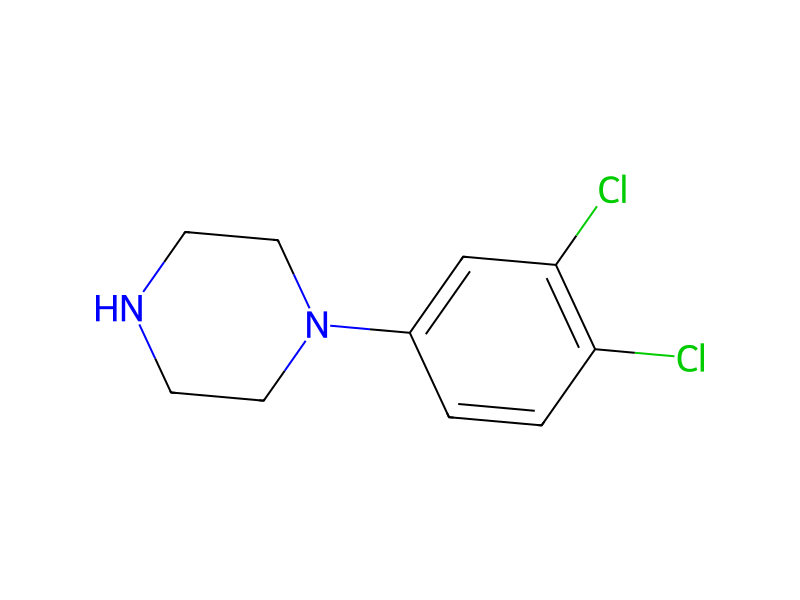
1-Bromo-2-Chloroethane → 1-(2-Chloroethyl)-4-(3,4-dichlorophenyl)piperazine
Reaction equation

[Cl:1][C:2]1[CH:3]=[C:4]([N:9]2[CH2:14][CH2:13][NH:12][CH2:11][CH2:10]2)[CH:5]=[CH:6][C:7]=1[Cl:8].Br[CH2:16][CH2:17][Cl:18].C(N(CC)CC)C>>[Cl:18][CH2:17][CH2:16][N:12]1[CH2:13][CH2:14][N:9]([C:4]2[CH:5]=[CH:6][C:7]([Cl:8])=[C:2]([Cl:1])[CH:3]=2)[CH2:10][CH2:11]1Participants
4



Conditions
- Temperature
- 100 °C
Procedure
A mixture of 1-(3,4-dichlorophenyl)-piperazine (0.05 mol), 1-bromo-2-chloroethane (0.1 mol) and triethylamine (0.05 mol) was stirred for 30 minutes at 100° C. The mixture was cooled, then partitioned between CH2Cl2 and water. The layers were separated. The organic phase was filtered over dicalite. The organic filtrate was dried, filtered and the filtrate was evaporated. The residue was purified by column chromatography over silica gel (eluent: CH2Cl2/CH3OH 98/2). The pure fractions were collected and the solvent was evaporated, yielding 5.2 g (35%) of 4-(2-chloroethyl)-1-(3,4-dichlorophenyl)-piperazine (interm. 9).
Workup
- temperatureThe mixture was cooled
- custompartitioned between CH2Cl2 and water
- customThe layers were separated
- filtrationThe organic phase was filtered over dicalite
- customThe organic filtrate was dried
- filtrationfiltered
- customthe filtrate was evaporated
- customThe residue was purified by column chromatography over silica gel (eluent: CH2Cl2/CH3OH 98/2)
- customThe pure fractions were collected
- customthe solvent was evaporated
Sources & evidence
- ORD record
- ord-d79e7e555f784a32b34d2bba6eaeeb0f
- Source dataset
- uspto-grants-2001_05
- Patent number
- US06224849B1
Reaction notes
Loading…