Glycerol → 2,2-Bis(trifluoromethyl)-4-hydroxymethyl-1,3-dioxolane
Reaction equation

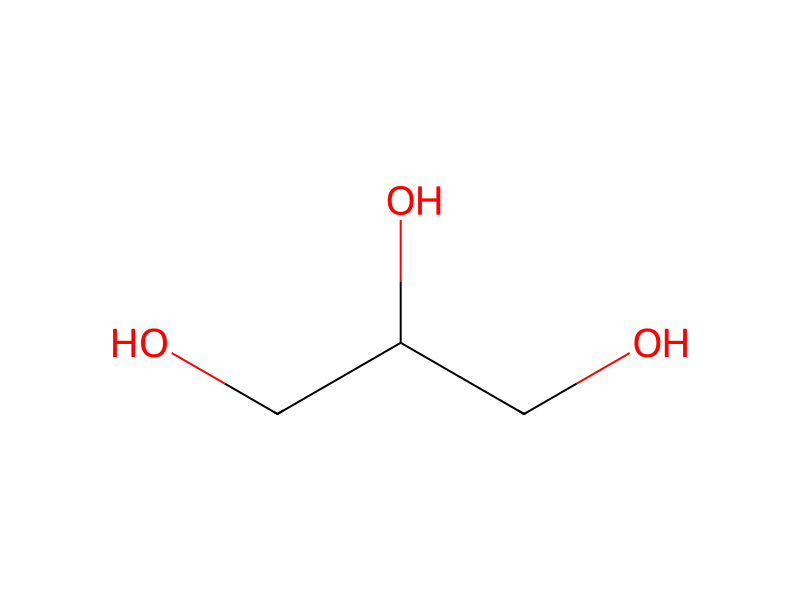
[F:1][C:2]([F:10])([F:9])[C:3]([C:5]([F:8])([F:7])[F:6])=[O:4].[OH:11][CH2:12][CH:13]([CH2:15]O)[OH:14]>COCCOC>[F:1][C:2]([F:10])([F:9])[C:3]1([C:5]([F:8])([F:7])[F:6])[O:14][CH:13]([CH2:12][OH:11])[CH2:15][O:4]1Participants
Reactant 2

Product 1

Reagents, catalysts & solvents 1

Procedure
In a 4 L round bottom flask, hexafluoroacetone (99.7 g; 0.6 moles) was condensed at 0° C. into a well stirred solution of glycerol (55.3 g; 0.6 moles) in 500 mL of anhydrous ethylene glycol dimethyl ether. After the addition of hexafluoroacetone was complete, the solution was allowed to warmn to ambient temperature. Next, a solution of 1,3-dieyclohexylcarbodiimide (136.2 g; 0.66 moles) in 2 L of anhydrous ethylene glycol dimethyl ether was added slowly to the resulting hemiketal solution over a period of about one and a half hours. The combined solution was stirred for an additional hour and then the low boiling solvent was removed using a rotary evaporator. The remaining liquid was transferred to a 250 mL round bottom flask and the liquid heated with stirring at 100° C. for 1 hour. While continuing to heat the liquid, the product was isolated by vacuum distillation at 76° C. and 18 mm of Hg. The yield of product was 117 g which is 81% of the theoretical value.
Workup
- customcondensed at 0° C. into a well
- customto warmn to ambient temperature
- customthe low boiling solvent was removed
- customa rotary evaporator
- customThe remaining liquid was transferred to a 250 mL round bottom flask
- temperaturethe liquid heated
- stirringwith stirring at 100° C. for 1 hour
- temperatureto heat the liquid
- customthe product was isolated by vacuum distillation at 76° C.
Sources & evidence
- ORD record
- ord-da05c9d2837d40899a03fa36070770e3
- Source dataset
- uspto-grants-2001_05
- Patent number
- US06231655B1
Reaction notes
Loading…