Succinic anhydride → HCID 14116665, compound
Reaction equation

[Cl:1][C:2]1[CH:7]=[CH:6][C:5]([C:8]2[CH:13]=[CH:12][CH:11]=[CH:10][CH:9]=2)=[CH:4][CH:3]=1.[C:14]1(=[O:20])[O:19][C:17](=[O:18])[CH2:16][CH2:15]1.[Cl-].[Al+3].[Cl-].[Cl-]>[N+](C1C=CC=CC=1)([O-])=O>[Cl:1][C:2]1[CH:3]=[CH:4][C:5]([C:8]2[CH:13]=[CH:12][C:11]([C:14](=[O:20])[CH2:15][CH2:16][C:17]([OH:19])=[O:18])=[CH:10][CH:9]=2)=[CH:6][CH:7]=1Participants
Reactant 3

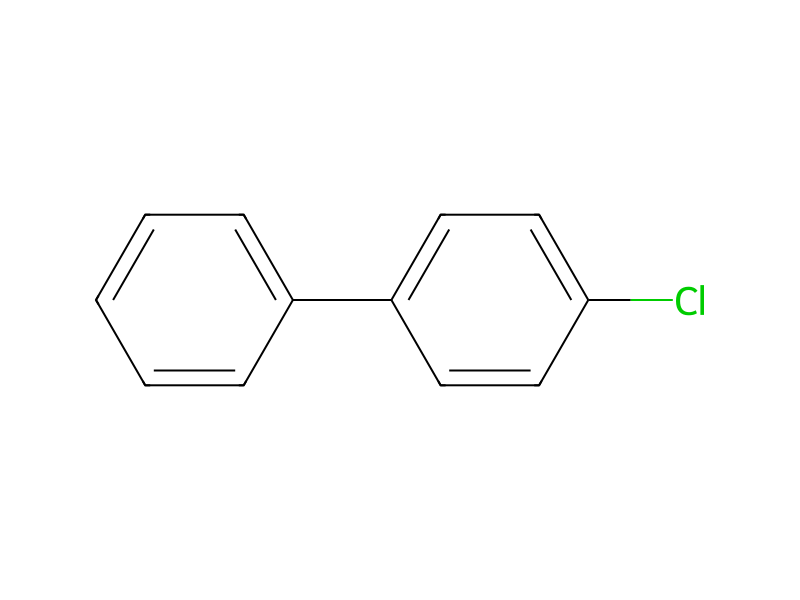

Product 1

Reagents, catalysts & solvents 1

Procedure
A suspension of 4-chlorobiphenyl (9.43 g, 0.0500 mol), succinic anhydride (5.50 g, 0.0550 mol), and anhydrous aluminum chloride (14.8 g, 0.111 mol) in nitrobenzene (25 mL) at 5° C. under nitrogen was stirred 4 hours, then allowed to warm to room temperature. After 3 days, the mixture was heated at 95° C. to 120° C. for 1 hour, cooled to 5° C., and quenched with a mixture of ice (15 g), water (8 mL), and concentrated hydrochloric acid (HCl) solution (8 mL). Additional water (150 mL) was added, followed by ethyl acetate. The ethyl acetate layer was washed with 0.2 M HCl and extracted with saturated aqueous sodium bicarbonate solution. The bicarbonate layer was rotary evaporated briefly to remove residual ethyl acetate, then acidified by the dropwise addition of concentrated HCl solution. The resulting tan precipitate was filtered off, washed with 0.2 M HCl, and air dried. The solids were dissolved in hot toluene/acetone, and the solution was decolorized with activated carbon, and filtered hot through celite. The filtrate was concentrated, and the resulting crystals were filtered, washed, and dried in vacuo to give 1.96 g of 4-(4′-chloro-biphenyl-4-yl)-4-oxo-butyric acid as pale yellow plates; mp 184-185° C.
Workup
- waitAfter 3 days
- temperaturethe mixture was heated at 95° C. to 120° C. for 1 hour
- temperaturecooled to 5° C.
- customquenched with a mixture of ice (15 g), water (8 mL), and concentrated hydrochloric acid (HCl) solution (8 mL)
- additionAdditional water (150 mL) was added
- washThe ethyl acetate layer was washed with 0.2 M HCl
- extractionextracted with saturated aqueous sodium bicarbonate solution
- customThe bicarbonate layer was rotary evaporated briefly
- customto remove residual ethyl acetate
- additionacidified by the dropwise addition of concentrated HCl solution
- filtrationThe resulting tan precipitate was filtered off
- washwashed with 0.2 M HCl, and air
- customdried
- dissolutionThe solids were dissolved in hot toluene/acetone
- filtrationfiltered hot through celite
- concentrationThe filtrate was concentrated
- filtrationthe resulting crystals were filtered
- washwashed
- customdried in vacuo
Sources & evidence
- ORD record
- ord-1aed3af9424243b893d95205039d4f7a
- Source dataset
- uspto-grants-2001_05
- Patent number
- US06239288B1
Reaction notes
Loading…