2,6-Dimethylnitrobenzene → 2,4,6-Trimethylaniline
Reaction equation

[CH3:1][C:2]1[CH:7]=[CH:6][CH:5]=[C:4]([CH3:8])[C:3]=1[N+:9]([O-])=O.[CH3:12][C:13]1[CH:19]=[CH:18][CH:17]=[C:16]([CH3:20])[C:14]=1N>[Ni]>[CH3:12][C:6]1[CH:7]=[C:2]([CH3:1])[C:3]([NH2:9])=[C:4]([CH3:8])[CH:5]=1.[C:18]1([CH3:1])[CH:19]=[C:13]([CH3:12])[CH:14]=[C:16]([CH3:20])[CH:17]=1Participants
Reactant 2

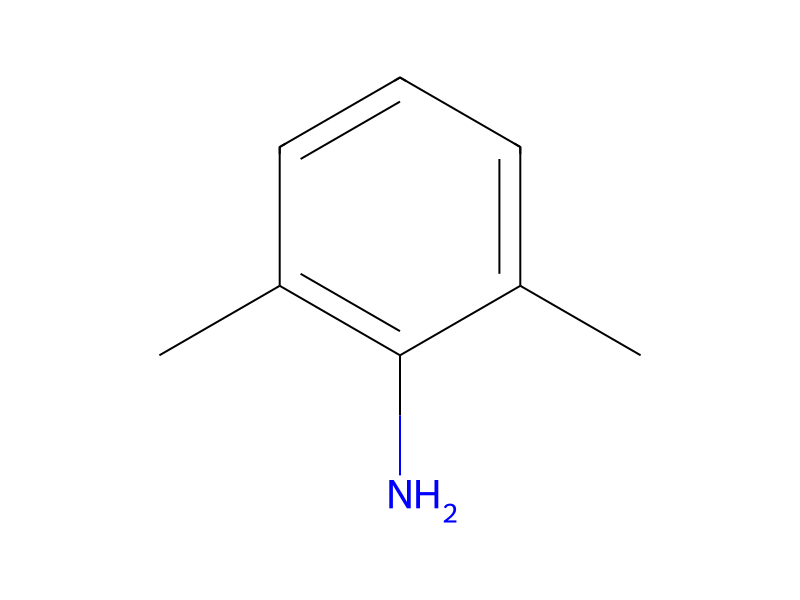
Product 2


Reagents, catalysts & solvents 1

Procedure
The 2,6-dimethylnitrobenzene is reduced to the amine, i.e., 2,6-dimethylaniline in the presence of a Raney nickel catalyst at a temperature of 25° C. and a pressure of 70 atmospheres: ##STR5## Mesidine (2,4,6-trimethylaniline) can be obtained in a similar manner by nitration of mesitylene followed by reduction. The aromatic amine is then reduced to an aliphatic amine with hydrogen in the presence of a hydrogenation catalyst such as Rh/Al2O3 in the range of 150 atmospheres and a temperature range of 90°-100° C., thusly: ##STR6## The thus formed 2,6-dimethylcyclohexylamine is then phosgenated to 2,6-dimethylcyclohexylisocyanate in the presence of chlorobenzene or dichlorobenzene solvent using excess phosgene and a two-stage temperature reaction wherein the first stage is carried out at -20° to 20° C. and the second from 110° to 180° C. while maintaining the reaction at a pressure in the range of 1 to 15 atmospheres: ##STR7##
Sources & evidence
- ORD record
- ord-2199a8f513fa43d49e26d8202b1b4ff0
- Source dataset
- uspto-grants-1985_04
- Patent number
- US04510097
Reaction notes
Loading…