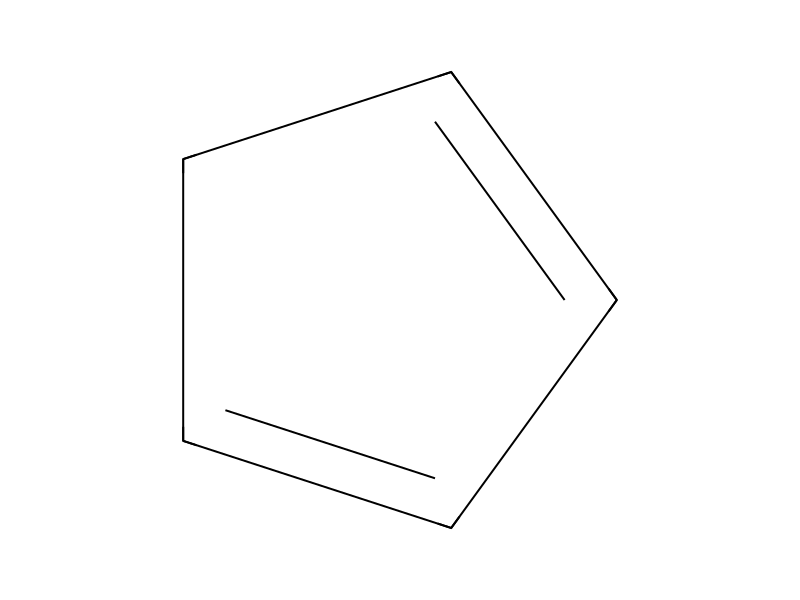
Dicyclopentadiene → Dicyclopentadiene
Reaction equation

[CH:1]1[CH2:5][CH:4]=[CH:3][CH:2]=1.[CH2:6]1[CH:10]2[CH:11]3[CH:15]=[CH:14][CH:13]([CH:9]2[CH:8]=[CH:7]1)[CH2:12]3>>[CH2:6]1[CH:10]2[CH:11]3[CH:15]=[CH:14][CH:13]([CH:9]2[CH:8]=[CH:7]1)[CH2:12]3.[CH2:7]=[CH:8][C:9](=[CH2:10])[CH3:13].[CH:5]1[CH2:4][CH:3]=[CH:2][CH:1]=1.[CH:5]1[CH2:4][CH:3]=[CH:2][CH:1]=1Participants
5


Conditions
- Temperature
- 160 °C
Procedure
A C5 fraction obtained from a naphtha cracking was heated at a temperature of 160° C. for 5 hours, whereby cyclopentadiene contained therein was converted into dicyclopentadiene. Then, the resultant mixture was distilled to strip a light fraction. Thus, a crude dicyclopentadiene containing 14.0% of a C5 fraction, 2.6% of benzene, 69.1% of dicyclopentadiene, 7.3% of a isoprene-cyclopentadiene codimer, 4.7% of a cyclopentadiene oligomer (i.e., a trimer or more) and 2.3% of unknown components was obtained.
Workup
- distillationThen, the resultant mixture was distilled
Sources & evidence
- ORD record
- ord-632f4a10dd7649b6a81ce219ecf65c3f
- Source dataset
- uspto-grants-1985_04
- Patent number
- US04513130
Reaction notes
Loading…