Phosphorus pentachloride → HCID 178526581, compound
Reaction equation
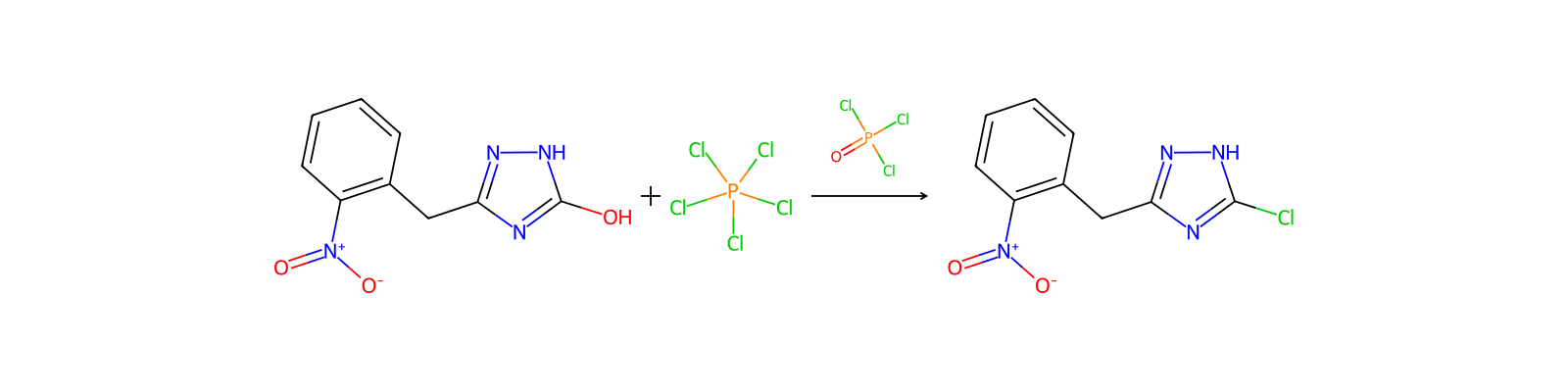
O[C:2]1[NH:6][N:5]=[C:4]([CH2:7][C:8]2[CH:13]=[CH:12][CH:11]=[CH:10][C:9]=2[N+:14]([O-:16])=[O:15])[N:3]=1.P(Cl)(Cl)(Cl)(Cl)[Cl:18]>P(Cl)(Cl)(Cl)=O>[Cl:18][C:2]1[NH:6][N:5]=[C:4]([CH2:7][C:8]2[CH:13]=[CH:12][CH:11]=[CH:10][C:9]=2[N+:14]([O-:16])=[O:15])[N:3]=1Participants
4
Reactant 2


Product 1

Reagents, catalysts & solvents 1

Procedure
A mixture of 1 g of 5-hydroxy-3-(o-nitrobenzyl)-1,2,4-triazole, 10 ml of phosphorus oxychloride and 1.89 g of phosphorus pentachloride is stirred at 70° for 11 hours, then at room temperature over the weekend and evaporated to dryness. The residue is dissolved in water, the solution is basified with 10% aqueous potassium carbonate and extracted 3 times with ethyl acetate. The combined extracts are dried over magnesium sulfate, decolorized with charcoal and evaporated to dryness. The residue is chromatographed with 50 g of silica gel using methylene chloride-ethyl acetate (1:1) as eluent to give 5-chloro-3-(o-nitrobenzyl)-1,2,4-triazole, m.p. 160°-163°.
Workup
- customat room temperature over the weekend and evaporated to dryness
- dissolutionThe residue is dissolved in water
- extractionextracted 3 times with ethyl acetate
- dry with materialThe combined extracts are dried over magnesium sulfate
- customevaporated to dryness
- customThe residue is chromatographed with 50 g of silica gel
Sources & evidence
- ORD record
- ord-079bf60e98db495da544043a7863a239
- Source dataset
- uspto-grants-1986_06
- Patent number
- US04595535
Reaction notes
Loading…