Dicyclohexylcarbodiimide → HCID 44385635, compound
Reaction equation

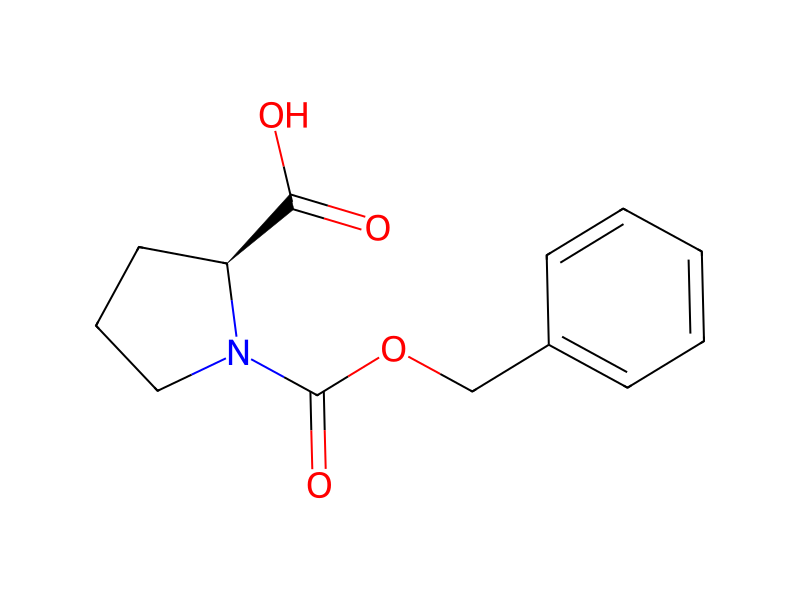
C1(COC(=O)[NH:10][C@H:11]([CH2:16][O:17][CH2:18][C:19]([NH2:21])=[O:20])[CH2:12][CH:13]([CH3:15])[CH3:14])C=CC=CC=1.[H][H].[C:25]([N:35]1[CH2:42][CH2:41][CH2:40][C@H:36]1[C:37]([OH:39])=O)([O:27][CH2:28][C:29]1[CH:34]=[CH:33][CH:32]=[CH:31][CH:30]=1)=[O:26].ON1C2C=CC=CC=2N=N1.C1(N=C=NC2CCCCC2)CCCCC1>[Pd].CO>[NH2:21][C:19](=[O:20])[CH2:18][O:17][CH2:16][CH:11]([NH:10][C:37]([CH:36]1[CH2:40][CH2:41][CH2:42][N:35]1[C:25]([O:27][CH2:28][C:29]1[CH:30]=[CH:31][CH:32]=[CH:33][CH:34]=1)=[O:26])=[O:39])[CH2:12][CH:13]([CH3:14])[CH3:15]Participants
Reactant 5




Product 1

Reagents, catalysts & solvents 2


Conditions
- Temperature
- 0 °C
Procedure
A stirred suspension of 1.58 g (0.0051 mol) of (S)-phenylmethyl-[1-[(2 amino-2-oxoethoxy)methyl]-3-methylbutyl]carbamate and 0.3 g of 20% palladium on carbon in a 100 ml of methanol is exposed to hydrogen gas for 15 minutes, the suspension is purged with nitrogen gas, filtered, and the solvent evaporated in vacuo at 30° C. The residue is dissolved in 100 ml of dichloromethane, the solution is cooled to 0° C. and 1.3 g (0.0051 mol) of carbobenzyloxyproline, 0.78 g (0.0051 mol) of 1-hyroxybenzotriazole and 1.1 g (0.0051 mol) of dicyclohexylcarbodiimide are added. The mixture is allowed to reach room temperature and stirred for 14 hours, filtered, the solvent evaporated in vacuo and the residue dissolved in 200 ml of dichloromethane and washed successively with a 5% aqueous solution of sodium carbonate, 2×200 ml, 10% aqueous solution of citric acid, 2×200 ml and a saturated aqueous solution of sodium chloride, 2×200 ml. The dichloromethane layer is separated, dried over sodium sulfate, evaporated in vacuo and the residue purified by chromatography using silica gel and eluting with dichloromethane-methanol (95:5) to give [S-(R*,R*)]-phenylmethyl 2[[[1-[(2-amino-2-oxoethoxy)methyl]-3-methylbutyl]amino]carbonyl]-1-pyrrolidinecarboxylate, 1.1 g; mp 146°-148°; [α]D25 -55.3° (c 1.31, methanol).
Workup
- customthe suspension is purged with nitrogen gas
- filtrationfiltered
- customthe solvent evaporated in vacuo at 30° C
- dissolutionThe residue is dissolved in 100 ml of dichloromethane
- customto reach room temperature
- filtrationfiltered
- customthe solvent evaporated in vacuo
- dissolutionthe residue dissolved in 200 ml of dichloromethane
- washwashed successively with a 5% aqueous solution of sodium carbonate, 2×200 ml, 10% aqueous solution of citric acid, 2×200 ml
- customThe dichloromethane layer is separated
- dry with materialdried over sodium sulfate
- customevaporated in vacuo
- customthe residue purified by chromatography
- washeluting with dichloromethane-methanol (95:5)
Sources & evidence
- ORD record
- ord-5aba1407b884414e9c85af70123897b9
- Source dataset
- uspto-grants-1986_06
- Patent number
- US04596819
Reaction notes
Loading…