1,4-Dibromobutane → 3-(1-Pyrrolidinyl)phenol
Reaction equation

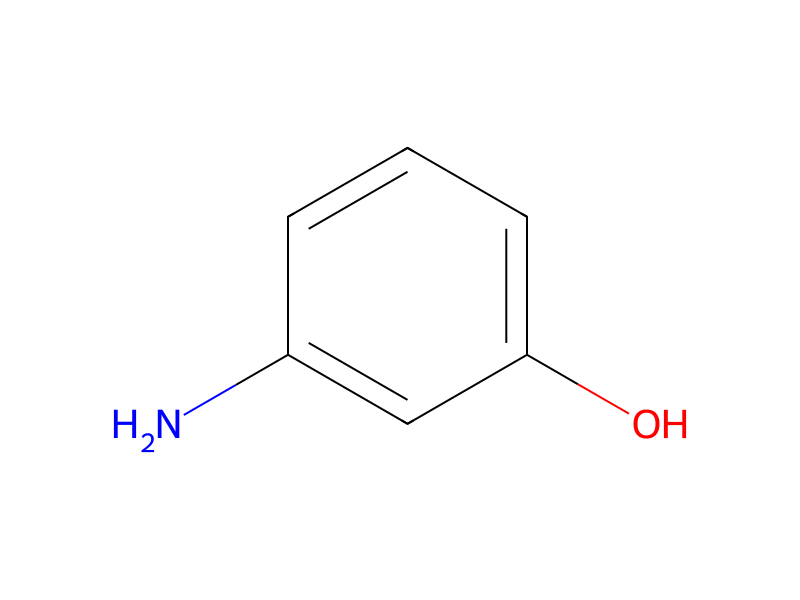
[NH2:1][C:2]1[CH:3]=[C:4]([OH:8])[CH:5]=[CH:6][CH:7]=1.Br[CH2:10][CH2:11][CH2:12][CH2:13]Br.C(N(CC)CC)C>C1(C)C=CC=CC=1>[N:1]1([C:2]2[CH:3]=[C:4]([OH:8])[CH:5]=[CH:6][CH:7]=2)[CH2:13][CH2:12][CH2:11][CH2:10]1Participants
Reactant 3


Product 1

Reagents, catalysts & solvents 1

Procedure
A solution of m-aminophenol (12.6 gm, 0.115 moles) and 1,4-dibromobutane (50 gm, 0.23 moles) was heated to 130° C. for 12 hr. The mixture was cooled to room temperature and triturated with diethylether and then ethyl acetate. The residue was dissolved in ethyl acetate and extracted with 1M NaOH, water, and sat. NaCl. After drying the organic layer with MgSO4, filtering, and evaporating solvent under vacuum, the crude product was purified by silica gel chromatography to give a pale yellow solid. The solid was refluxed with 500 ml toluene and 17 ml triethylamine (0.12 moles) for one hr, cooled to room temperature and washed with water and sat. NaCl. The solution was dried again over MgSO4, filtered, and evaporated under vacuum to give 3-pyrrolidinylphenol as a white solid (6.0 gm, 0.037 moles, 32%).
Workup
- customtriturated with diethylether
- dissolutionThe residue was dissolved in ethyl acetate
- extractionextracted with 1M NaOH, water, and sat. NaCl
- dry with materialAfter drying the organic layer with MgSO4
- filtrationfiltering
- customevaporating solvent under vacuum
- customthe crude product was purified by silica gel chromatography
- customto give a pale yellow solid
- temperaturecooled to room temperature
- washwashed with water and sat. NaCl
- dry with materialThe solution was dried again over MgSO4
- filtrationfiltered
- customevaporated under vacuum
Sources & evidence
- ORD record
- ord-a0598b9a66664f0fa97c2284ec29a7d8
- Source dataset
- uspto-grants-2009_06
- Patent number
- US07550570B2
Reaction notes
Loading…