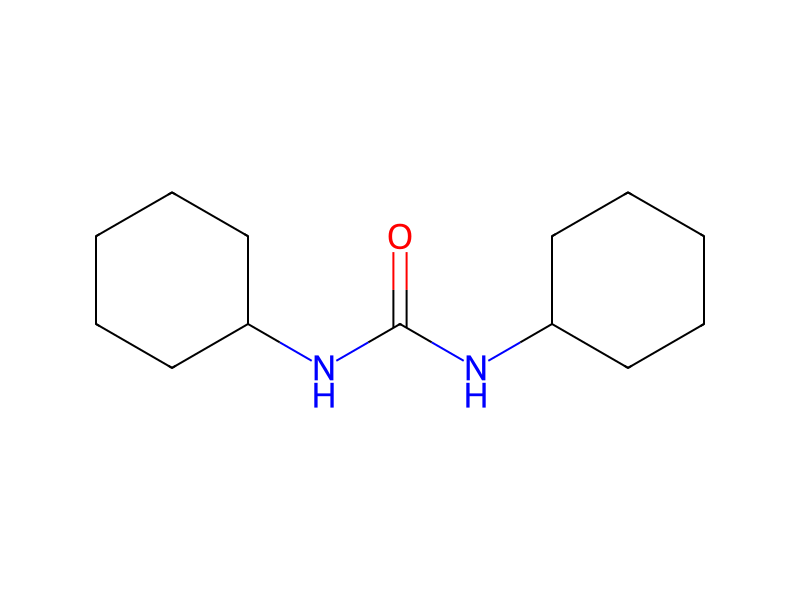
N,N'-Dicyclohexylurea → HCID 21918630, compound
Reaction equation

[C:1]([OH:14])(=O)[C:2]1[CH:12]=[C:9]([O:10][CH3:11])[C:7]([OH:8])=[C:4]([O:5][CH3:6])[CH:3]=1.OC1C2N=NNC=2C=CC=1.C1(N=C=NC2CCCCC2)CCCCC1.[N+:40]([C:43]1[CH:48]=[CH:47][C:46]([N:49]2[CH2:54][CH2:53][NH:52][CH2:51][CH2:50]2)=[CH:45][CH:44]=1)([O-:42])=[O:41].C(NC1CCCCC1)(NC1CCCCC1)=O>CN(C=O)C>[CH3:6][O:5][C:4]1[CH:3]=[C:2]([C:1]([N:52]2[CH2:53][CH2:54][N:49]([C:46]3[CH:45]=[CH:44][C:43]([N+:40]([O-:42])=[O:41])=[CH:48][CH:47]=3)[CH2:50][CH2:51]2)=[O:14])[CH:12]=[C:9]([O:10][CH3:11])[C:7]=1[OH:8]Participants
7





Procedure
In a 100 ml flask, 0.99 g (5 mmoles) of syringic acid, 0.74 g (5.5 mmoles) of hydroxybenzotriazol, 1.10 g (5.5 mmoles) of dicyclohexylcarbodiimide and 1.04 g (5 mmoles) of 1-(4-nitrophenyl)piperazine are dissolved in 10 ml of DMF. After agitation at ambient temperature for 7 hours, the mixture is filtered and the precipitate rinsed with 20 ml of DMF followed by 100 ml of chloroform 2 g of a yellow powder is obtained, containing approximately 20% of dicyclohexylurea. The product is used as it is in the following stage.
Workup
- filtrationthe mixture is filtered
- washthe precipitate rinsed with 20 ml of DMF
- customis obtained
Sources & evidence
- ORD record
- ord-3ee00fb16860462686c0b10104c307d1
- Source dataset
- uspto-grants-2009_06
- Patent number
- US07553976B2
Reaction notes
Loading…