p-Fluoronitrobenzene → 1-Boc-4-(4-Nitrophenyl)piperazine
Reaction equation

F[C:2]1[CH:7]=[CH:6][C:5]([N+:8]([O-:10])=[O:9])=[CH:4][CH:3]=1.C(=O)([O-])[O-].[K+].[K+].[C:17]([N:24]1[CH2:29][CH2:28][NH:27][CH2:26][CH2:25]1)([O:19][C:20]([CH3:23])([CH3:22])[CH3:21])=[O:18]>CS(C)=O.O>[C:17]([N:24]1[CH2:25][CH2:26][N:27]([C:2]2[CH:7]=[CH:6][C:5]([N+:8]([O-:10])=[O:9])=[CH:4][CH:3]=2)[CH2:28][CH2:29]1)([O:19][C:20]([CH3:23])([CH3:22])[CH3:21])=[O:18]Participants
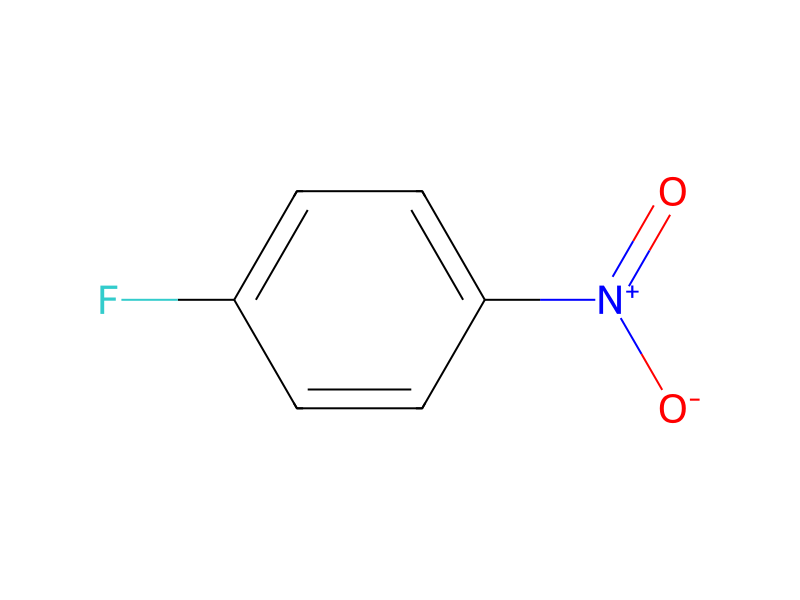





Conditions
- Temperature
- 100 °C
Procedure
To a suspension of 1-fluoro-4-nitrobenzene (1.4 mL, 13 mmol) and potassium carbonate (2.5 g, 18 mmol) in DMSO (10 mL) was added 1-Boc-piperazine (2.75 g, 14.8 mmol). The mixture was stirred at 100° C. for 2 hours. After cooing down, the mixture was diluted with water (50 mL) and extracted with EtOAc (3×50 mL). The combined organic layers were washed with brine, dried with sodium sulfate (Na2SO4), and concentrated in vacuo to afford a yellow solid. Recrystallization from EtOAC/hexanes gave 4.0 g of 1-(4-Boc-piperazin-1-yl)-4-nitrobenzene, which was reduced via hydrogenation to give the title compound (purple solid, 3 g). 1H NMR (400 MHz, CDCl3) δ (ppm): 6.68 (d, J=8.8 Hz, 2H), 6.64 (d, J=8.8 Hz, 2H), 3.56 (t, J=5.0 Hz, 4H), 2.96 (t, J=5.0 Hz, 4H), 1.46 (s, 9H).
Workup
- extractionextracted with EtOAc (3×50 mL)
- washThe combined organic layers were washed with brine
- dry with materialdried with sodium sulfate (Na2SO4)
- concentrationconcentrated in vacuo
- customto afford a yellow solid
- customRecrystallization from EtOAC/hexanes
Sources & evidence
- ORD record
- ord-dd55d5b9f81c4dc79f3ab454146b96ab
- Source dataset
- uspto-grants-2010_01
- Patent number
- US07642270B2
Reaction notes
Loading…