Lithium Hydroxide → 2-Bromo-1,3-thiazole-4-carboxylic acid
Reaction equation

C([O:3][C:4]([C:6]1[N:7]=[C:8]([Br:11])[S:9][CH:10]=1)=[O:5])C.[Li+].[OH-]>CO.O>[Br:11][C:8]1[S:9][CH:10]=[C:6]([C:4]([OH:5])=[O:3])[N:7]=1Participants
5
Reactant 2

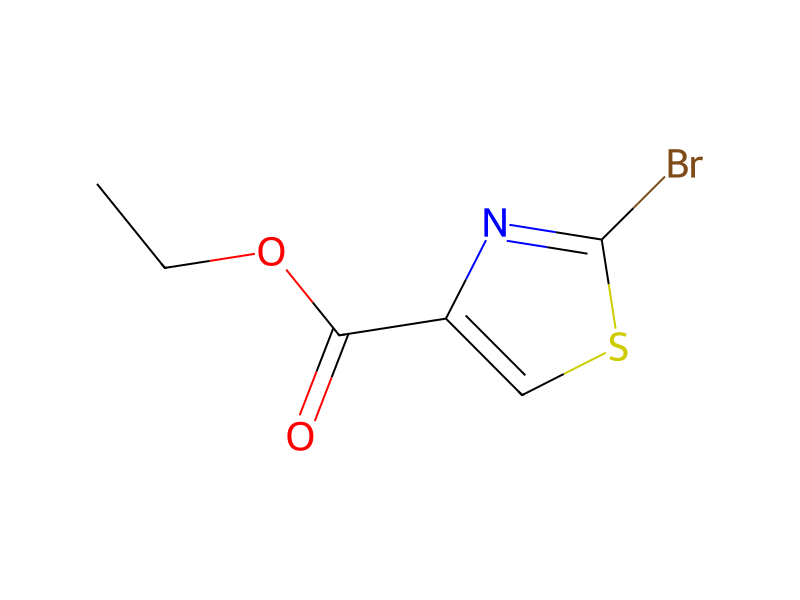
Product 1

Reagents, catalysts & solvents 2


Procedure
To a solution of 2-bromo-thiazole-4-carboxylic acid ethyl ester (Combi-Blocks, Inc., San Diego, Calif.; 5 g, 21.2 mmol) in MeOH (25 mL) and water (25 mL) was added LiOH (0.56 g, 23.3 mmol). After stirring for 4 h at reflux temperature, MeOH was evaporated in vacuo. To the residue was added more water, the mixture was acidified to pH 2 with concentrated HCl (3 mL), and extracted with EtOAc. The combined extracts were evaporated to give 2-bromo-thiazole-4-carboxylic acid which was used without further purification. The compounds of the present invention were preferably prepared by methods A to F:
Workup
- customwas evaporated in vacuo
- additionTo the residue was added more water
- extractionextracted with EtOAc
- customThe combined extracts were evaporated
Sources & evidence
- ORD record
- ord-f18a04ff8fc541c197f0d420b87b9063
- Source dataset
- uspto-grants-2010_01
- Patent number
- US07645773B2
Reaction notes
Loading…