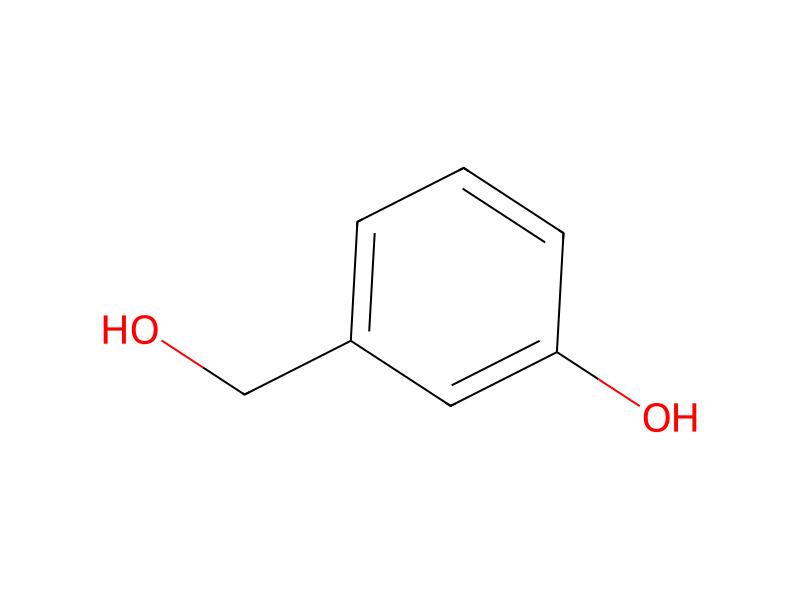
Water → 3-Hydroxybenzyl alcohol
Reaction equation

[C:1]1(P(=O)([O-])[O-])[CH:6]=[CH:5][CH:4]=[CH:3][CH:2]=1.[OH2:11].[OH-].[Na+].[O:14]1[CH2:18]CCC1>>[OH:11][C:3]1[CH:2]=[C:1]([CH:6]=[CH:5][CH:4]=1)[CH2:18][OH:14]Participants




Procedure
Scheme 20, Example 1 illustrates the preparation of carbamates employing a chloroformyl derivative of the carbinol 20.5. In this procedure, the carbinol 20.5 is reacted with phosgene, in an inert solvent such as toluene, at about 0°, as described in Org. Syn. Coll. Vol. 3, 167, 1965, or with an equivalent reagent such as trichloromethoxy chloroformate, as described in Org. Syn. Coll. Vol. 6, 715, 1988, to afford the chloroformate 20.6. The latter compound is then reacted with the amine component 20.3, in the presence of an organic or inorganic base, to afford the carbamate 20.7. For example, the chloroformyl compound 20.6 is reacted with the amine 20.3 in a water-miscible solvent such as tetrahydrofuran, in the presence of aqueous sodium hydroxide, as described in Org. Syn. Coll. Vol. 3, 167, 1965, to yield the carbamate 20.7. Alternatively, the reaction is performed in dichloromethane in the presence of an organic base such as diisopropylethylamine or dimethylaminopyridine.
Sources & evidence
- ORD record
- ord-d0a06926bda74533986ac32c932f066a
- Source dataset
- uspto-grants-2010_01
- Patent number
- US07649015B2
Reaction notes
Loading…