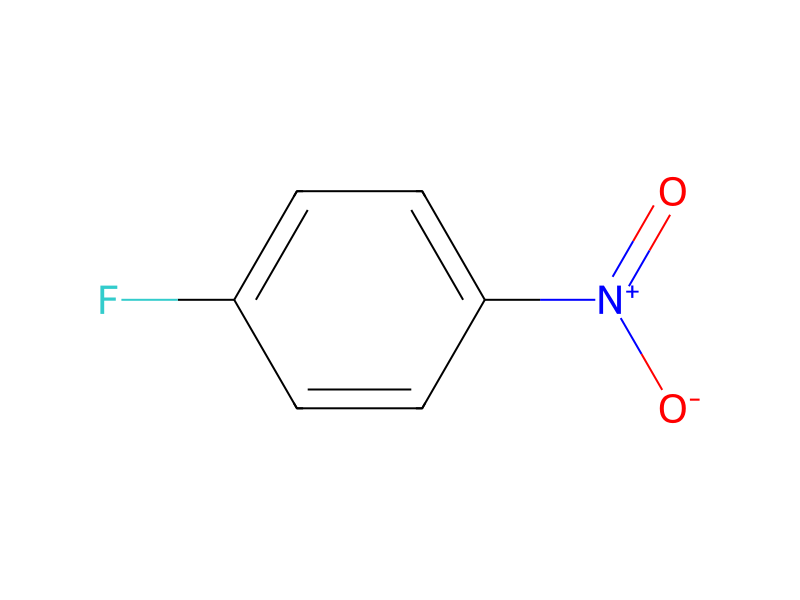
p-Fluoronitrobenzene → Pyridine, 4-(4-nitrophenoxy)-2-(trifluoromethyl)-
Reaction equation

[F:1][C:2]([F:11])([F:10])[C:3]1[CH:8]=[C:7]([OH:9])[CH:6]=[CH:5][N:4]=1.F[C:13]1[CH:18]=[CH:17][C:16]([N+:19]([O-:21])=[O:20])=[CH:15][CH:14]=1.[OH-].[Na+]>CN(C=O)C>[N+:19]([C:16]1[CH:17]=[CH:18][C:13]([O:9][C:7]2[CH:6]=[CH:5][N:4]=[C:3]([C:2]([F:1])([F:10])[F:11])[CH:8]=2)=[CH:14][CH:15]=1)([O-:21])=[O:20]Participants
5
Reactant 3


Product 1

Reagents, catalysts & solvents 1

Conditions
- Temperature
- 100 °C
Procedure
A mixture of 2-trifluoromethyl-pyridin-4-ol (0.675 g, 4.14 mmol), 1-fluoro-4-nitro-benzene (0.54 mL, 4.97 mmol, 1.2 equiv), and NaOH (0.203 g,4.97 mmol, 1.2 equiv) in DMF abs. is heated to 100° C. (oil bath temperature) for 21.5 h, under an argon atmosphere. The reaction mixture is allowed to cool to rt, filtered through a glass sintered funnel and concentrated in vacuo. The residual yellow solid is purified by silica gel (100 g) column chromatography (CH2Cl2/hexane, 70/30) to afford the title compound as a white solid: ES-MS: 285.0 [M+H]+; single peak at tR=8.71 min (System 2); Rf=0.25 (CH2Cl2/hexane, 70/30).
Workup
- temperatureto cool to rt
- filtrationfiltered through a glass sintered funnel
- concentrationconcentrated in vacuo
- customThe residual yellow solid is purified by silica gel (100 g) column chromatography (CH2Cl2/hexane, 70/30)
Sources & evidence
- ORD record
- ord-bc84324fc59b46d28082ffb71e378f5b
- Source dataset
- uspto-grants-2010_01
- Patent number
- US07652022B2
Reaction notes
Loading…