Ethyl 2-(diphenylmethyleneamino)acetate → Ethyl 2-(diphenylmethyleneamino)-2-(pent-4-enyl)hept-6-enoate
Reaction equation

[CH2:1]([O:3][C:4](=[O:20])[CH2:5][N:6]=[C:7]([C:14]1[CH:19]=[CH:18][CH:17]=[CH:16][CH:15]=1)[C:8]1[CH:13]=[CH:12][CH:11]=[CH:10][CH:9]=1)[CH3:2].C[Si]([N-][Si](C)(C)C)(C)C.[K+].I[CH2:32][CH2:33][CH2:34][CH:35]=[CH2:36]>C1COCC1>[C:8]1([C:7](=[N:6][C:5]([CH2:15][CH2:14][CH2:7][CH:8]=[CH2:9])([CH2:32][CH2:33][CH2:34][CH:35]=[CH2:36])[C:4]([O:3][CH2:1][CH3:2])=[O:20])[C:14]2[CH:19]=[CH:18][CH:17]=[CH:16][CH:15]=2)[CH:9]=[CH:10][CH:11]=[CH:12][CH:13]=1Participants

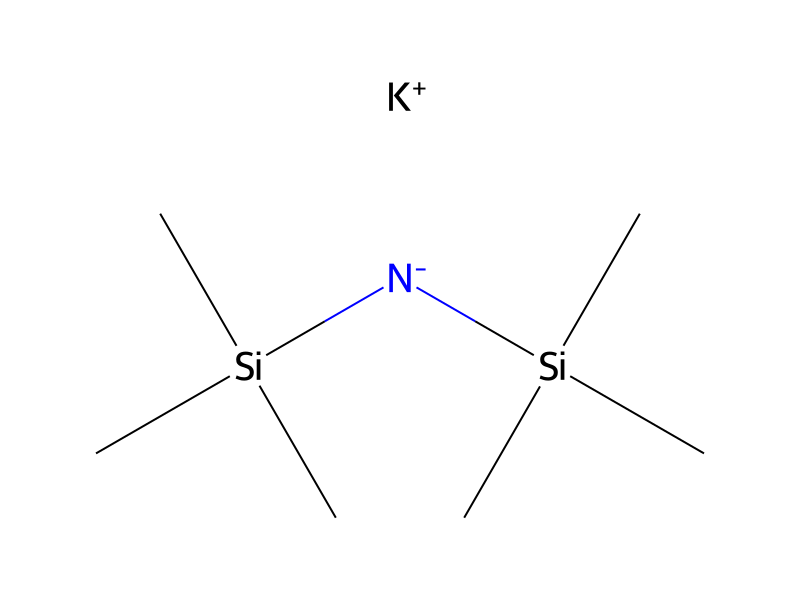



Conditions
- Temperature
- -78 °C
Procedure
A procedure previously described for dialkylation of N-(diphenylmethylene)glycine ethyl ester was used after modifications (see Denmark, S. E.; Stavenger, R. A.; Faucher, A.-M.; Edwards, J. P. J. Org. Chem. 1997, 62, 3375-3389): To a stirred solution of N-(diphenylmethylene)glycine ethyl ester 10 (13.63 g, 51 mmol) in THF (250 mL) was added a solution of KHMDS (11.2 g, 56.1 mmol, 1.1 equiv.) in THF (56 mL) via a cannula at −78° C. over 15 min. After stirring at −78° C. for 1 h, the resulting orange-colored solution was treated with 5-iodo-1-pentene (12 g, 61.2 mmol, 1.2 equiv.). The reaction mixture was allowed to warm to room temperature and stirred for 2 h. The resulting suspension was cooled to −40° C. and another solution of KHMDS (15.3 g, 76.5 mmol, 1.5 equiv.) in THF (77 mL) was added via a cannula over 15 min and stirred for 1 h. 5-iodo-1-pentene (16 g, 81.6 mmol, 1.6 equiv.) was then quickly added to the burgundy-colored mixture, and the reaction was left to warm to room temperature overnight (16 h). The reaction was quenched by addition of saturated NH4Cl solution in water (100 mL). The organics were extracted with ethyl acetate (2×150 mL), washed with Na2S2O3 solution and then with brine. The organic layer was dried over MgSO4, filtered, and concentrated under reduced pressure. The resulting residue was dried in vacuo overnight and used for the next reaction without further purification: 1H-NMR (400 MHz, CDCl3) δ 7.83-7.12 (m, 10H), 5.80 (m, 2H), 5.02 (dd, J=17.2, 1.6 Hz, 2H), 4.96 (dd, J=10.4, 1.6 Hz, 2H), 3.74 (q, J=6.8 Hz, 2H), 2.05 (dd, J=14.0, 7.2 Hz, 4H), 1.92 (m, 4H), 1.45 (m, 4H), 1.13 (t, J=6.8 Hz, 3H); 13C-NMR (100 MHz, CDCl3) δ 174.8, 166.0, 141.3, 138.9, 128.5, 128.2, 127.9, 115.0, 69.2, 60.5, 37.5, 34.4, 23.3, 14.2; HRMS (ESI) m/z for C27H34NO2 [M+H]+ calcd 404.2589. found 404.2577.
Workup
- temperatureto warm to room temperature
- stirringstirred for 2 h
- temperatureThe resulting suspension was cooled to −40° C.
- stirringstirred for 1 h
- waitthe reaction was left
- temperatureto warm to room temperature overnight (16 h)
- customThe reaction was quenched by addition of saturated NH4Cl solution in water (100 mL)
- extractionThe organics were extracted with ethyl acetate (2×150 mL)
- washwashed with Na2S2O3 solution
- dry with materialThe organic layer was dried over MgSO4
- filtrationfiltered
- concentrationconcentrated under reduced pressure
- customThe resulting residue was dried in vacuo overnight
- customused for the next reaction without further purification
Sources & evidence
- ORD record
- ord-a77cc0ebd3294154a627ac1626d75c98
- Source dataset
- uspto-grants-2013_11
- Patent number
- US08592377B2
Reaction notes
Loading…