Bromobenzene → 1,3-Benzenedimethanol, alpha1,alpha3-dimethyl-alpha1,alpha3-diphenyl-
Reaktionsgleichung

Br[C:2]1[CH:7]=[CH:6][CH:5]=[CH:4][CH:3]=1.[Mg].[C:9]([C:12]1[CH:17]=[CH:16][CH:15]=[C:14]([C:18](=[O:20])[CH3:19])[CH:13]=1)(=[O:11])[CH3:10]>C(OCC)C.C1C=CC=CC=1>[C:2]1([C:18]([C:14]2[CH:15]=[CH:16][CH:17]=[C:12]([C:9]([OH:11])([C:2]3[CH:7]=[CH:6][CH:5]=[CH:4][CH:3]=3)[CH3:10])[CH:13]=2)([OH:20])[CH3:19])[CH:7]=[CH:6][CH:5]=[CH:4][CH:3]=1Komponenten
Edukt 3

Produkt 1

Reagenzien, Katalysatoren, Lösungsmittel 2

Versuchsvorschrift
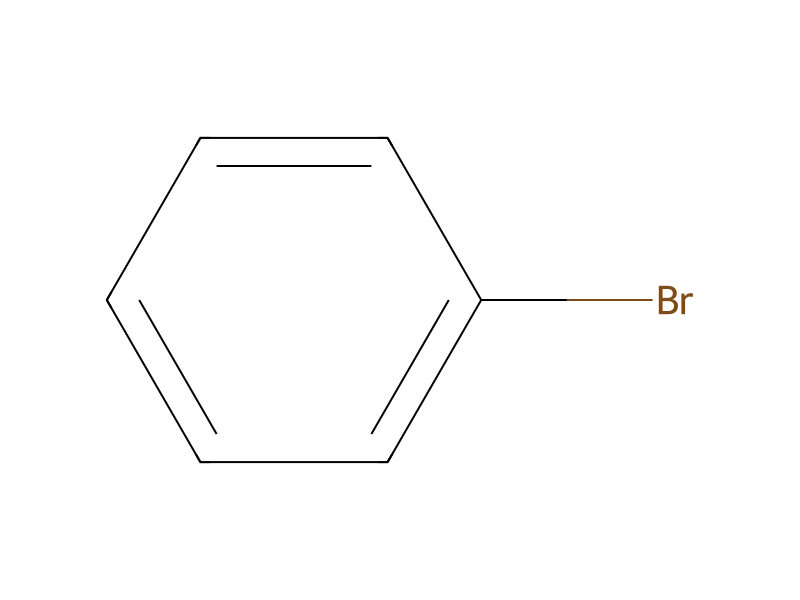
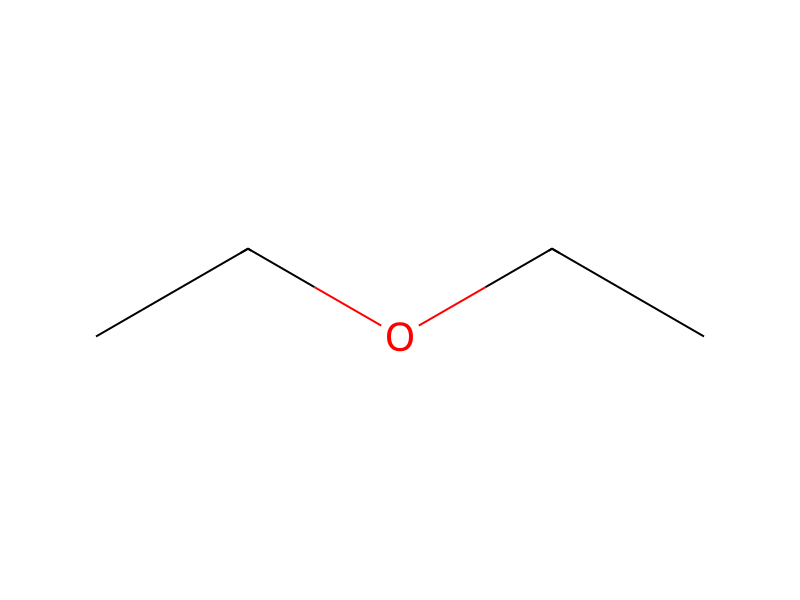
A Grignard reagent was prepared by admixing 0.4 mole of bromobenzene with 0.6 mole of magnesium turnings in 260 milliliters of diethyl ether. After the reaction was complete, the resultant solution was added over a period of twenty minutes to 0.1 mole of meta-diacetylbenzene dissolved in 500 milliliters of benzene. The resultant mixture was refluxed at atmospheric pressure for a period of two hours and the contents of the reaction vessel were then poured into ice water. After agitation, in separatory funnel, the water and organic layer were separated, the aqueous layer discarded, the organic layer washed with water and then with a saturated aqueous solution of sodium chloride. The remaining organic layer was dried with anhydrous magnesium sulfate and the dried organic layer was evaporated in a rotary evaporator providing 1,3-di(1-phenyl-1-hydroxyethyl)benzene. The product was then dissolved in 500 milliliters of benzene which contained 0.25 gram of toluene sulfonic acid monohydrate. The benzene solution was then refluxed for a period of two and one-half hours using a Dean Stark assembly. When refluxing was completed, the mixture was cooled, washed with water, aqueous sodium bicarbonate and a third wash with saturated aqueous sodium chloride solution. The organic layer was then dried with anhydrous magnesium sulfate and the benzene was then removed employing a rotary evaporator. The residue was a brown oil which was distilled under a pressure of about 0.1 millimeter of mercury. The fraction boiling from about 154° C. to 160° C. was a supercooled viscous yellow oil. Infrared and nuclear magnetic resonance spectroscopy were employed to confirm that the product was 1,3-di(1-phenylethenyl)benzene (Compound II). The oil was a supercooled liquid and can be used directly in the preparation of a dilithium initiator as set forth in the following description or crystallized before use. A portion of the oil was dissolved in warm ethanol in a glass container, the resulting ethanol solution cooled to about -20° C. and the inner wall of the breaker rubbed with a glass stirring rod to initiate crystallization. Later crystallizations employed seeding. The crystals are colorless, needlelike and melt over the range 45.5° to 46.5° C. A solution was prepared of 0.96 millimole of Compound II in a 20 milliliters of toluene contained in a nitrogen-filled flask equipped with a magnetic stirrer and a rubber septum capped side arm. To this mixture were added 2.03 millimoles of secondary butyllithium in cyclohexane. The reaction mixture turned redish-brown in color and the temperature was maintained between about 28° and 30° C. No precipitate was observed at any time. The reaction mixture was sampled periodically after the addition of the secondary butyllithium by withdrawing 4 milliliter aliquots. The aliquots were withdrawn at 10 minutes, 30 minutes, 60 minutes, 90 minutes and 180 minutes after the addition of the secondary butyllithium. Each of the aliquots were mixed with 0.1 milliliter of glacial acetic acid. The aliquots were then centrifuged to remove lithium acetate. After removal of the lithium acetate, most of the solvent was removed by evaporation. The remaining products were then analyzed by gel permeation chromatography which showed the complete transformation of Compound II to 1,3-phenylene-bis-(3-methyl-1-phenylpentylidene) bis-(lithium) within 30 minutes.
Aufarbeitung
- customAfter agitation, in separatory funnel, the water and organic layer were separated
- washthe organic layer washed with water
- dry with materialThe remaining organic layer was dried with anhydrous magnesium sulfate
- customthe dried organic layer was evaporated in a rotary evaporator
Quellen und Nachweise
- ORD-Eintrag
- ord-aee58b9e516943a3b0458cd7df490218
- Quelldatensatz
- uspto-grants-1980_04
- Patentnummer
- US04196154
Notizen zur Reaktion
Wird geladen…