Ethylene Glycol → Glycero-gulo-heptose
Reaction equation

[O:1]=[CH:2][CH:3]([CH2:5][OH:6])[OH:4].[CH2:7]([OH:10])[CH2:8][OH:9].[CH:11](=[O:14])[CH2:12][OH:13]>CO>[CH2:11]([OH:14])[C@@H:12]([OH:13])[C@@H:7]([OH:10])[C@H:8]([OH:9])[C@@H:5]([OH:6])[C@@H:3]([OH:4])[CH:2]=[O:1]Participants
Reactant 3

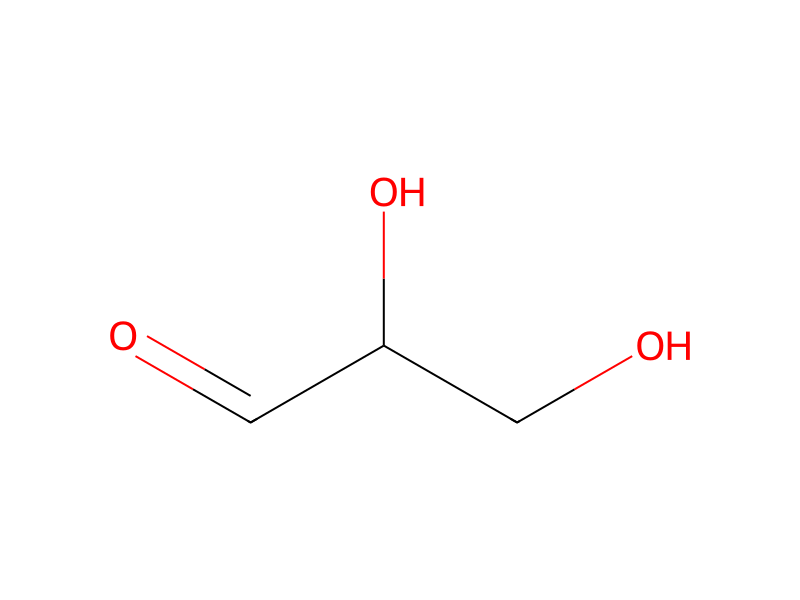

Product 1

Reagents, catalysts & solvents 1

Procedure
Using the above described procedure of Example 1, glucose (Example 2) was cleanly decarbonylated by one equivalent of chlorotris(triphenylphosphine)rhodium to yield arabinitol (88%) in about 4 hours. Similarly, arabinose (Example 3) yielded erythritol (84%). Glyceraldehyde (Example 4), which has a higher free aldehyde content (ca. 2% in aqueous solution at room temperature), yielded ethylene glycol (95%) in just 30 minutes under the same conditions. Similar results were observed with glycol aldehyde, which yielded methanol (83%) and glucoheptose which yielded glucitol (88%) (Example 5). A practical demonstration of the utility of this reaction is provided by the one-step conversion of commercially available 2-deoxyribose (Example 6) into the much less accessible 1-deoxyerythritol (30 min., >90%). This is particularly significant in that the best known synthesis of 1-deoxyerythritol requires seven steps from glucose [Chaby, R., et al., Tetrahedron, 27:3197-3205 (1971)].
Workup
- customSimilar results
Sources & evidence
- ORD record
- ord-a5f614e066734fb1a029ba82dd87d3fd
- Source dataset
- uspto-grants-1991_05
- Patent number
- USH0000918
Reaction notes
Loading…