Isopropanol → HCID 67926897, compound
Reaction equation

[Si](OC[C@H:10]1[CH2:15][CH2:14][C@H:13]2[C@H:16]3[C@H:26]([CH2:27][CH2:28][C@:11]12C)[C@:24]1([CH3:25])[C@H:19]([CH:20]=[C:21]([C:29]([O:31][CH3:32])=[O:30])[CH2:22][CH2:23]1)[CH2:18][CH2:17]3)(C(C)(C)C)(C)C.C[C:34]([CH3:36])=[O:35].[OH:37]S(O)(=O)=O.O=[Cr](=O)=O.C(O)(C)C>CC(C)=O>[C:29]([C:21]1[CH2:22][CH2:23][C@@:24]2([CH3:25])[CH:19]([CH2:18][CH2:17][C@@H:16]3[C@@H:26]2[CH2:27][CH2:28][C@@:11]2([CH3:10])[C@H:13]3[CH2:14][CH2:15][C@@H:36]2[C:34]([OH:37])=[O:35])[CH:20]=1)([O:31][CH3:32])=[O:30]Participants
5
Reactant 3


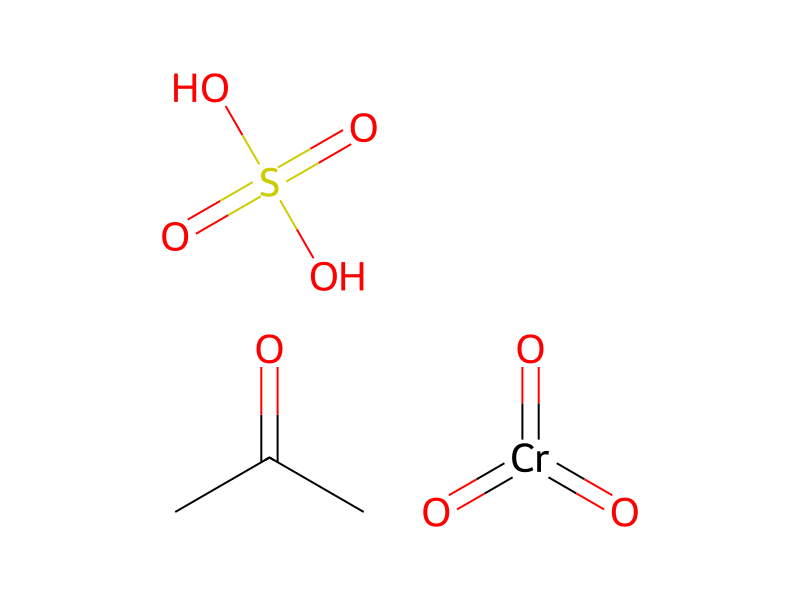
Product 1

Reagents, catalysts & solvents 1

Procedure
Methyl 17β-(t-butyldimethylsilyloxymethyl) -5α-androst-3-ene-3-carboxylate (500 mg), was dissolved in 150 ml acetone. Jones reagent was added until a red color persisted. Isopropanol was then added to quench excess Jones reagent. The acetone was decanted off and the residual chromium salts were then dissolved in water and washed 3 times with dichloromethane. The organic layers were combined and passed through a plug of florosil and concentrated to give 360 mg (99%) of 3-carbomethoxy-3-androstene-17β-carboxylic acid.
Workup
- customto quench excess Jones reagent
- customThe acetone was decanted off
- dissolutionthe residual chromium salts were then dissolved in water
- washwashed 3 times with dichloromethane
- concentrationconcentrated
Sources & evidence
- ORD record
- ord-6cf81900344f4a079e0ab45328e26650
- Source dataset
- uspto-grants-1991_05
- Patent number
- US05017568
Reaction notes
Loading…