2-Chloro-3-nitrobenzoic acid → (2-Chloro-3-nitrophenyl)methanol
Reaction equation

[Cl:1][C:2]1[C:10]([N+:11]([O-:13])=[O:12])=[CH:9][CH:8]=[CH:7][C:3]=1[C:4](O)=[O:5]>O1CCCC1>[Cl:1][C:2]1[C:10]([N+:11]([O-:13])=[O:12])=[CH:9][CH:8]=[CH:7][C:3]=1[CH2:4][OH:5]Participants
Reactant 1
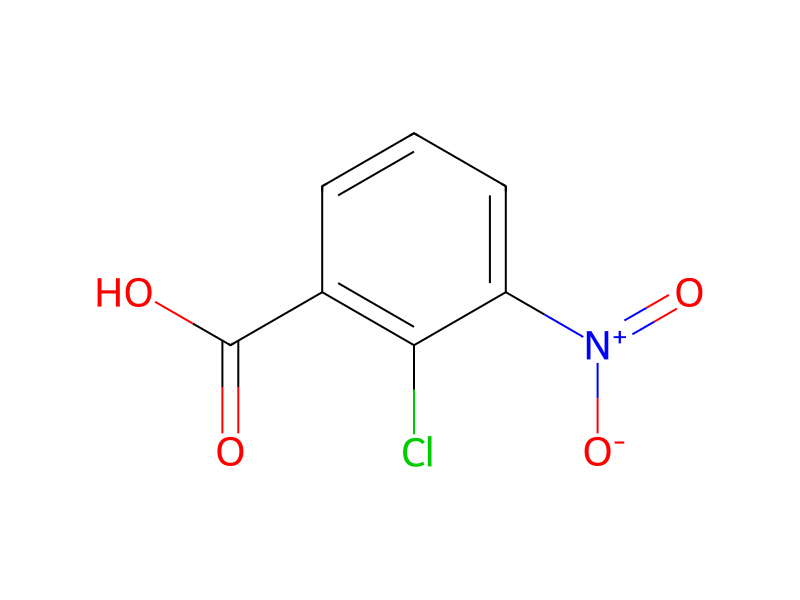
Product 1

Reagents, catalysts & solvents 1

Procedure
A solution of 2-chloro-3-nitrobenzoic acid (1.0 g, 5.0 mmol) in tetrahydrofuran (10 mL) is cooled to 0° C. under an argon atmosphere. Boranetetrahydrofuran complex (6.4 mL of a 1.0 M solution) is added dropwise, maintaining a reaction temperature of less than 5° C. After the addition is complete, the reaction mixture is stirred for 6 hours at room temperature. It is then cooled in an ice bath and quenched by the addition of 10 mL of 1.0 N HCl. The reaction mixture is heated at reflux for 30 minutes and concentrated by distilling the THF. The remaining aqueous solution is extracted with methylene chloride, and the organic layer is washed with saturated aqueous bicarbonate and brine. Evaporation of the organic layer followed by recrystallization of the residue from hexane gives 2-chloro-3-nitrobenzenemethanol (0.4 g, 43%), mp=69-70° C.
Workup
- temperaturemaintaining a reaction temperature of less than 5° C
- additionAfter the addition
- temperatureIt is then cooled in an ice bath
- customquenched by the addition of 10 mL of 1.0 N HCl
- temperatureThe reaction mixture is heated
- temperatureat reflux for 30 minutes
- concentrationconcentrated
- distillationby distilling the THF
- extractionThe remaining aqueous solution is extracted with methylene chloride
- washthe organic layer is washed with saturated aqueous bicarbonate and brine
- customEvaporation of the organic layer
- customfollowed by recrystallization of the residue from hexane
Sources & evidence
- ORD record
- ord-5709c87cd8b54e8e87d47d9e2fd155f4
- Source dataset
- uspto-grants-1991_05
- Patent number
- US05017604
Reaction notes
Loading…