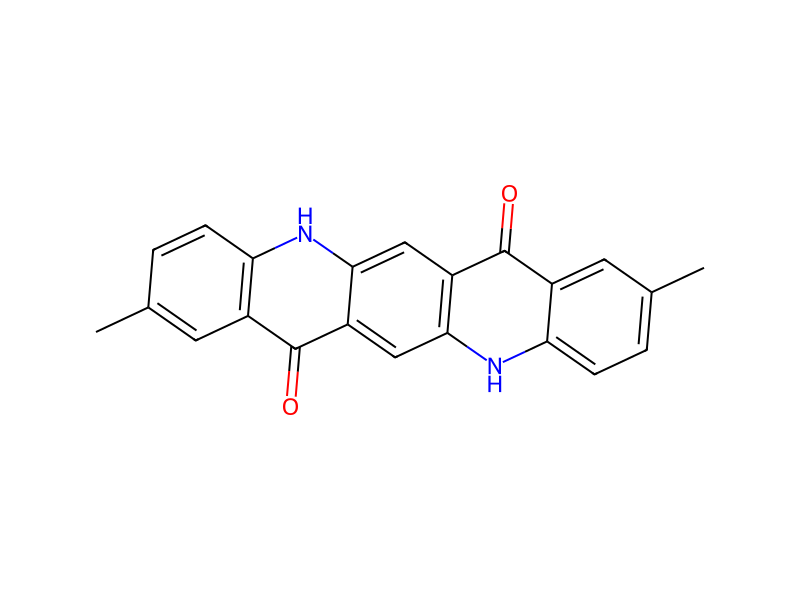
2,5-Di-p-toluidinoterephthalic acid → 5,12-Dihydro-2,9-dimethylquino(2,3-b)acridine-7,14-dione
Reaction equation

[CH3:1][C:2]1[CH:7]=[CH:6][C:5]([NH:8][C:9]2[CH:17]=[C:16]([C:18]([OH:20])=O)[C:15]([NH:21][C:22]3[CH:27]=[CH:26][C:25]([CH3:28])=[CH:24][CH:23]=3)=[CH:14][C:10]=2[C:11]([OH:13])=O)=[CH:4][CH:3]=1>O>[CH3:28][C:25]1[CH:26]=[CH:27][C:22]2[NH:21][C:15]3[C:16]([C:18](=[O:20])[C:23]=2[CH:24]=1)=[CH:17][C:9]1[NH:8][C:5]2[CH:6]=[CH:7][C:2]([CH3:1])=[CH:3][C:4]=2[C:11](=[O:13])[C:10]=1[CH:14]=3Participants
3
Reactant 1

Product 1
Reagents, catalysts & solvents 1

Procedure
2,5-Bis{(4-methylphenyl)amino}terephthalic acid (3.76 gm; 10 mmol) and polyphosphoric acid (40 gm) were heated at 150° C. for 2.5 hours under a nitrogen atmosphere. The mixture was allowed to cool and then poured into iced water (100 ml) when a magenta solid precipitated out. This was filtered off, washed with water and then methanol, then dried under vacuum over phosphorous pentoxide to give 3.12 gm (92%) of 2,9-dimethylquinacridone.
Workup
- temperatureto cool
- customprecipitated out
- filtrationThis was filtered off
- washwashed with water
- dry with materialmethanol, then dried under vacuum over phosphorous pentoxide
Sources & evidence
- ORD record
- ord-f9ce1475c72e4c618d782cee7a9b28df
- Source dataset
- uspto-grants-2008_02
- Patent number
- US07335771B2
Reaction notes
Loading…