Methanol → Ethyl 2-(acetylamino)-4-methylthiophene-3-carboxylate
Reaction equation

Cl[CH2:2][C:3](=O)[CH3:4].[SH-:6].[Na+].[CH2:8]([O:10][C:11](=[O:15])[CH2:12][C:13]#[N:14])[CH3:9].C(N([CH2:21][CH3:22])CC)C.C[OH:24]>O>[C:21]([NH:14][C:13]1[S:6][CH:2]=[C:3]([CH3:4])[C:12]=1[C:11]([O:10][CH2:8][CH3:9])=[O:15])(=[O:24])[CH3:22]Participants
Reactant 5





Product 1
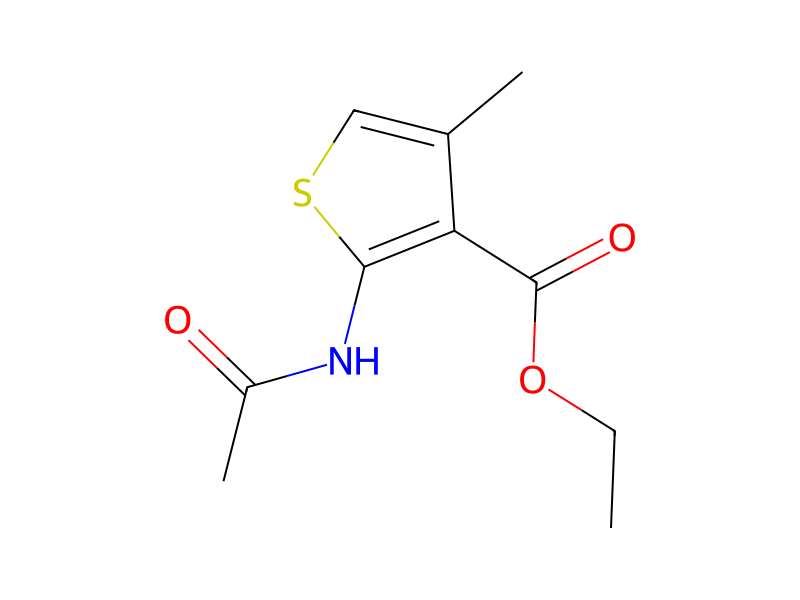
Reagents, catalysts & solvents 1

Procedure
Chloroacetone was reacted with sodium hydrosulphide in aqueous methanol, and the resulting solution containing the reaction product treated with ethylcyanoacetate in the presence of triethylamine at the boil. Addition of water precipitated 2-amino-3-ethoxycarbonyl-4-methylthiophene which was reacted with acetic anhydride to give 2-acetylamino-3-ethoxycarbonyl-4-methylthiophene which on hydrolysis with an aqueous solution of sodium hydroxide was converted to 2-acetylamino-4-methylthiophene-3-carboxylic acid. This was decarboxylated by heating in N:N-diethylaniline at 220° C., and the resulting 2-acetylamino-4-methylthiophene dinitrated in sulphuric acid medium at -5° C. The resulting product was then heated in an aqueous solution of sulphuric acid to remove the N-acetyl group.
Workup
- additionthe resulting solution containing the reaction product
- customprecipitated 2-amino-3-ethoxycarbonyl-4-methylthiophene which
- customwas reacted with acetic anhydride
Sources & evidence
- ORD record
- ord-377582247091471b849ebe844fe691bc
- Source dataset
- uspto-grants-1980_07
- Patent number
- US04211696
Reaction notes
Loading…