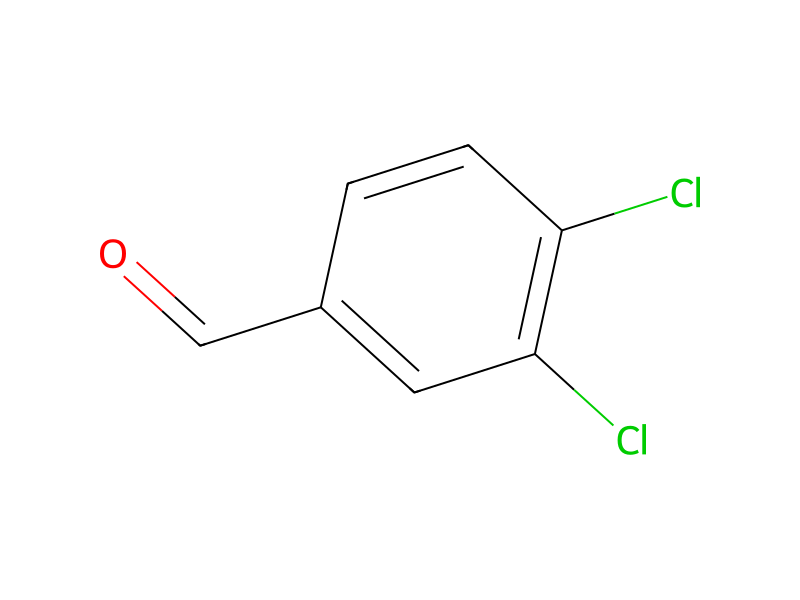
3,4-Dichlorobenzaldehyde → HCID 53700981, compound
Reaction equation

[Cl:1][C:2]1[CH:3]=[C:4]([CH:7]=[CH:8][C:9]=1[Cl:10])[CH:5]=O.[CH2:11]([Mg]Br)[CH3:12]>>[Cl:10][C:9]1[CH:8]=[CH:7][C:4]([CH:5]=[CH:11][CH3:12])=[CH:3][C:2]=1[Cl:1]Participants


Procedure
With the exception of three compounds, the styrene compounds herein utilized for preparing the α-chloro oximes are known and their preparations are published in the prior art. The compounds not previously known are synthesized following well-known published procedures. Thus, 2-bromobenzaldehyde is allowed to react with a Grignard reagent, ethyl magnesium bromide in anhydrous ether, to yield 1-(2-bromophenyl)propanol. This propanol derivative is then dehydrated by refluxing it in toluene in the presence of p-toluenesulfonic acid catalyst to yield the desired 1-bromo-2-(1-propenyl)benzene. Another previously unknown substituted styrene, namely, 1,2-dichloro-4-(1-propenyl)benzene is prepared by the same general procedure from 3,4-dichlorobenzaldehyde and ethyl magnesium bromide, followed by dehydration of the intermediate substituted propanol.
Sources & evidence
- ORD record
- ord-28efc211baec44ebb6eec60fd2460d59
- Source dataset
- uspto-grants-1980_07
- Patent number
- US04211870
Reaction notes
Loading…