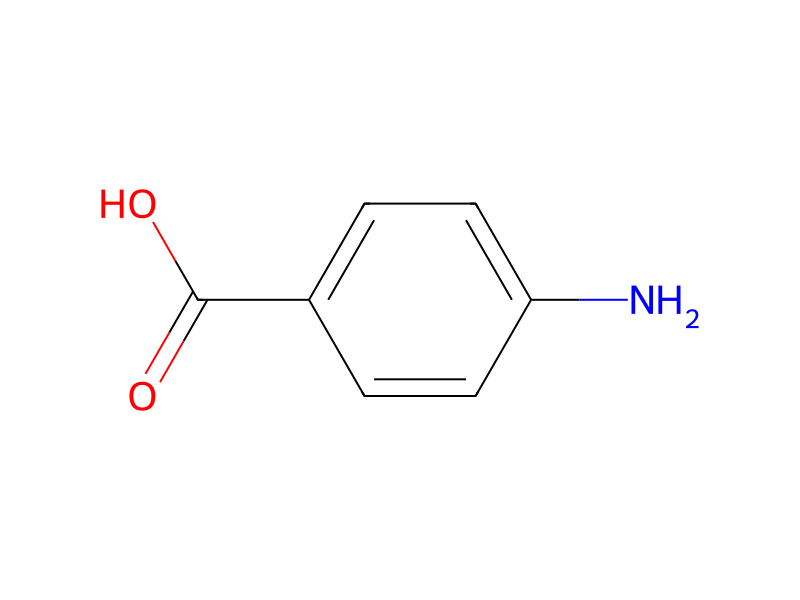
4-Aminobenzoic Acid → Poly(p-phenylene terephthalamide)
Reaction equation

[CH:1]1[C:6]([NH2:7])=[CH:5][CH:4]=[C:3]([NH2:8])[CH:2]=1.CN(C)P(N(C)C)(N(C)C)=[O:12].N[C:21]1[CH:29]=[CH:28][C:24]([C:25]([OH:27])=[O:26])=[CH:23][CH:22]=1.[C:30](Cl)(=[O:40])C1C=CC(C(Cl)=O)=CC=1>O>[CH:23]1[C:24]([C:25]([OH:27])=[O:26])=[CH:28][CH:29]=[C:21]([C:30]([OH:40])=[O:12])[CH:22]=1.[CH:5]1[C:6]([NH2:7])=[CH:1][CH:2]=[C:3]([NH2:8])[CH:4]=1Participants
6
Reactant 4


Product 1

Reagents, catalysts & solvents 1

Procedure
To a solution of p-phenylenediamine (31.08 g., 0.287 mole) in a mixture of 360 ml. of hexamethylphosphoramide and 180 ml. of N-methylpyrrolidone-2 is added 3.36 g. of p-aminobenzoic acid, using water bath cooling. To this cooled solution is added terephthaloyl chloride (60.90 g., 0.300 mole.) The reaction mixture is stirred overnight, then combined with water in a blender to precipitate polymer. The product is washed with water and dried in a vacuum oven at 65° C. The product is then combined with acetone in a blender, the mixture filtered, and the product collected and dried at 65° C. in a vaccum oven. There is obtained a quantitative yield of poly(p-phenylene terephthalamide) (ηinh=1.32).
Workup
- temperaturecooling
- customto precipitate polymer
- washThe product is washed with water
- customdried in a vacuum oven at 65° C
- filtrationthe mixture filtered
- customthe product collected
- customdried at 65° C. in a vaccum oven
Sources & evidence
- ORD record
- ord-5f4f6324624b45a7be5e9ea19c9575c4
- Source dataset
- uspto-grants-1980_07
- Patent number
- USRE030352
Reaction notes
Loading…