Dimethylamine → N,N,1,3-tetramethyl-4-nitropyrazole-5-carboxamide
Reaction equation

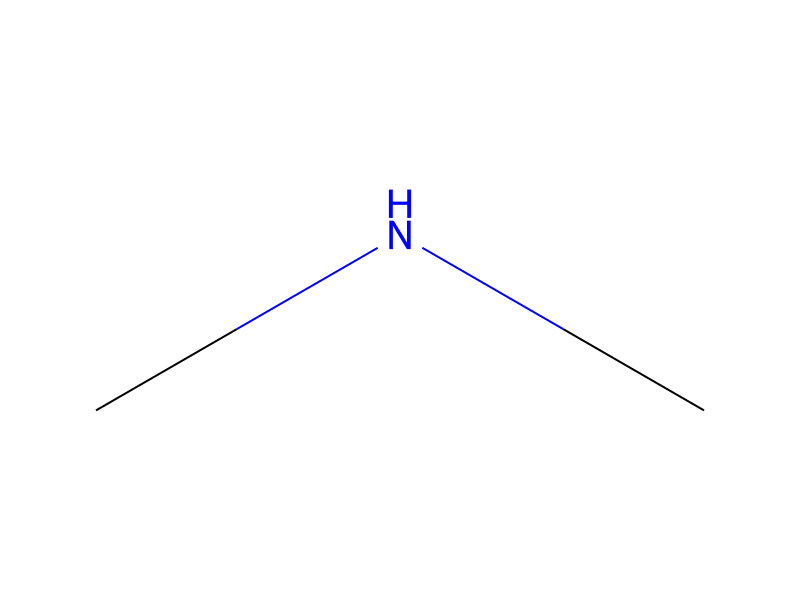
[CH3:1][N:2]1[C:6]([C:7](Cl)=[O:8])=[C:5]([N+:10]([O-:12])=[O:11])[C:4]([CH3:13])=[N:3]1.[CH3:14][NH:15][CH3:16].C(=O)([O-])[O-].[K+].[K+]>C(Cl)Cl>[CH3:14][N:15]([CH3:16])[C:7]([C:6]1[N:2]([CH3:1])[N:3]=[C:4]([CH3:13])[C:5]=1[N+:10]([O-:12])=[O:11])=[O:8]Participants




Procedure
A solution of 40 g of 1,3-dimethyl-4-nitropyrazole--5-carboxylic acid chloride in 50 ml of methylene chloride is added dropwise at from 10° to 20° C., while cooling, to 43 g of a 40% strength aqueous solution of dimethylamine; stirring is continued for a further 20 minutes. The resulting mixture is rendered alkaline with potassium carbonate; the organic layer is separated off, and the aqueous phase is extracted by shaking it with methylene chloride. The organic solution is dried and concentrated, and the residue is triturated with petroleum ether (bp 40° to 70° C.) to yield 38.3 g of N,N,1,3-tetramethyl-4-nitropyrazole-5-carboxamide, mp 57° to 59.5° C., which is converted into a product of mp 114° to 115.5° C. on recrystallization from cyclohexane.
Workup
- customthe organic layer is separated off
- extractionthe aqueous phase is extracted
- stirringby shaking it with methylene chloride
- customThe organic solution is dried
- concentrationconcentrated
- customthe residue is triturated with petroleum ether (bp 40° to 70° C.)
Sources & evidence
- ORD record
- ord-b4dc527967fb49e68bdb72c91070988d
- Source dataset
- uspto-grants-1982_03
- Patent number
- US04317823
Reaction notes
Loading…