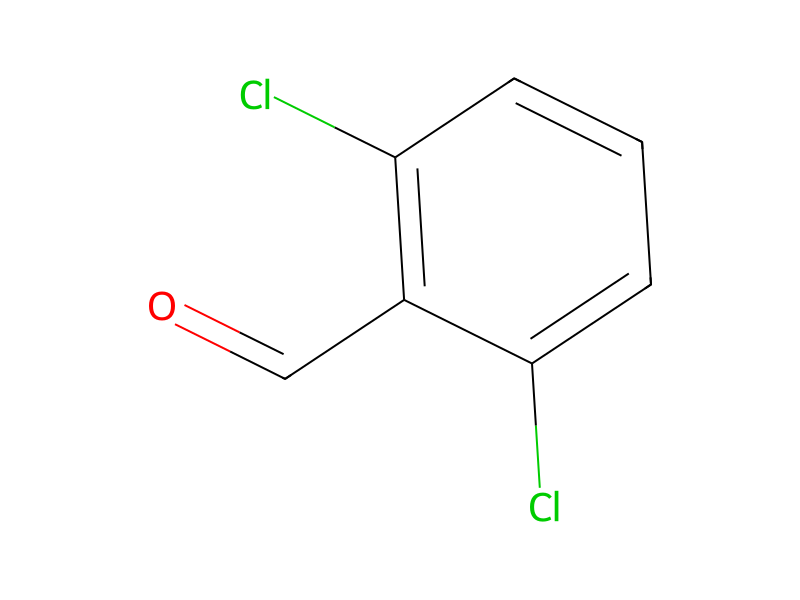
2,6-Dichlorobenzaldehyde → HCID 12818460, compound
Reaction equation

[CH3:1][N:2]1[CH2:7][C:6](O)=[CH:5][C:4](=[O:9])[CH2:3]1.[Cl:10][C:11]1[CH:18]=[CH:17][CH:16]=[C:15]([Cl:19])[C:12]=1[CH:13]=O.[CH3:20][O:21][C:22](=[O:27])/[CH:23]=[C:24](\[NH2:26])/[CH3:25]>C(O)C>[CH3:20][O:21][C:22]([C:23]1[CH:13]([C:12]2[C:11]([Cl:10])=[CH:18][CH:17]=[CH:16][C:15]=2[Cl:19])[C:5]2[C:4](=[O:9])[CH2:3][N:2]([CH3:1])[CH2:7][C:6]=2[NH:26][C:24]=1[CH3:25])=[O:27]Participants
5
Reactant 3


Product 1

Reagents, catalysts & solvents 1

Procedure
A mixture of 7.25 g. of 1-methyl-3-oxo-5-hydroxy-1,2,3,6-tetrahydropyridine, 8.75 g. of 2,6-dichlorobenzaldehyde, 5.94 g. of methyl-3-aminocrotonate (97%) and 135 ml. of ethanol were heated at reflux for 3 hours. The mixture was filtered and the filtrate was evaporated to dryness. The residue was slurried with ethanol and the solid was separated by filtration. The solid, m.p. 258°-260° C. dec, was suspended in ethanol and saturated with hydrogen chloride. The solution was evaporated to dryness. The residue was triturated with a small volume of ethanol and filtered. The solid was recrystallized from 95% ethanol to obtain the title compound as the hydrochloride, m.p. 260°-262° C. dec.
Workup
- additionA mixture of 7.25 g
- temperatureat reflux for 3 hours
- filtrationThe mixture was filtered
- customthe filtrate was evaporated to dryness
- customthe solid was separated by filtration
- customThe solution was evaporated to dryness
- customThe residue was triturated with a small volume of ethanol
- filtrationfiltered
- customThe solid was recrystallized from 95% ethanol
Sources & evidence
- ORD record
- ord-11987de8482d44e98d780106ed7b29ff
- Source dataset
- uspto-grants-1982_03
- Patent number
- US04321384
Reaction notes
Loading…