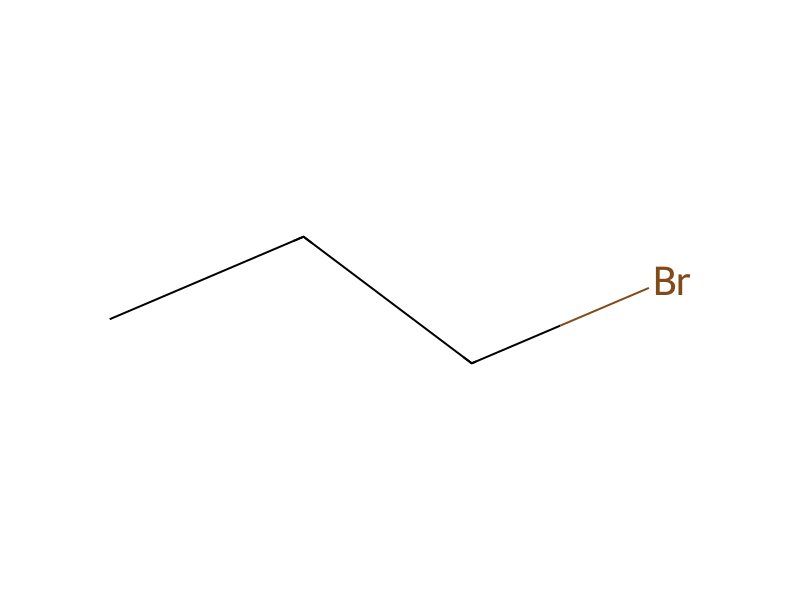
1-Bromopropane → HCID 59550052, compound
Reaction equation

[C:1]12([C:14]([OH:16])=[O:15])[CH2:10][CH:5]3[CH2:6][CH:7]([CH2:9][C:3]([C:11]([OH:13])=[O:12])([CH2:4]3)[CH2:2]1)[CH2:8]2.Br[CH2:18][CH2:19][CH3:20].N1(C2CCCCCCCCCC2)CCCN=CCC[CH2:24][CH2:23][CH2:22]1>C(#N)C.C(OCC)(=O)C>[C:1]12([C:14]([O:16][CH2:22][CH2:23][CH3:24])=[O:15])[CH2:8][CH:7]3[CH2:6][CH:5]([CH2:4][C:3]([C:11]([O:13][CH2:18][CH2:19][CH3:20])=[O:12])([CH2:9]3)[CH2:2]1)[CH2:10]2Participants
Reactant 3


Product 1

Reagents, catalysts & solvents 2


Procedure
Di-n-propyl 1,3-adamantanedicarboxylate is prepared by way of the following procedure. A 50 mL round bottom flask equipped with a magnetic stir bar is charged with 1,3-admantanedicarboxylic acid (3.36 g, 15.0 mmol), 1-bromopropane (3.28 mL, 36.0 mmol) and 1,8-diazabicycloundec-7-ene (5.38 mL, 36.0 mmol) in 25 mL acetonitrile. The mixture is heated to reflux overnight and cooled to room temperature. The reaction is diluted with 100 mL of ethyl acetate and washed with saturated NH4Cl/1N HCl, water, saturated sodium bicarbonate, and then brine. The organic layer is dried over sodium sulfate. After filtration, the filtrate is concentrated, and the residue is dried in vacuo. The crude product is further purified by distillation in vacuo to yield the product as a white liquid.
Workup
- customA 50 mL round bottom flask equipped with a magnetic stir bar
- temperatureThe mixture is heated
- temperatureto reflux overnight
- washwashed with saturated NH4Cl/1N HCl, water, saturated sodium bicarbonate
- dry with materialThe organic layer is dried over sodium sulfate
- filtrationAfter filtration
- concentrationthe filtrate is concentrated
- customthe residue is dried in vacuo
- distillationThe crude product is further purified by distillation in vacuo
Sources & evidence
- ORD record
- ord-7f636379821c42b1a8c232191667ce57
- Source dataset
- uspto-grants-2012_10
- Patent number
- US08288304B2
Reaction notes
Loading…