4-Bromo-2-nitroaniline → HCID 22478116, compound
Reaction equation

[C:1]([C:3]1[CH:4]=[C:5](B(O)O)[CH:6]=[CH:7][CH:8]=1)#[N:2].Br[C:13]1[CH:19]=[CH:18][C:16]([NH2:17])=[C:15]([N+:20]([O-:22])=[O:21])[CH:14]=1>O1CCCC1.[Pd].C1(P(C2C=CC=CC=2)C2C=CC=CC=2)C=CC=CC=1.C1(P(C2C=CC=CC=2)C2C=CC=CC=2)C=CC=CC=1.C1(P(C2C=CC=CC=2)C2C=CC=CC=2)C=CC=CC=1.C1(P(C2C=CC=CC=2)C2C=CC=CC=2)C=CC=CC=1>[NH2:17][C:16]1[CH:18]=[CH:19][C:13]([C:5]2[CH:6]=[CH:7][CH:8]=[C:3]([C:1]#[N:2])[CH:4]=2)=[CH:14][C:15]=1[N+:20]([O-:22])=[O:21]Participants
5
Reactant 2

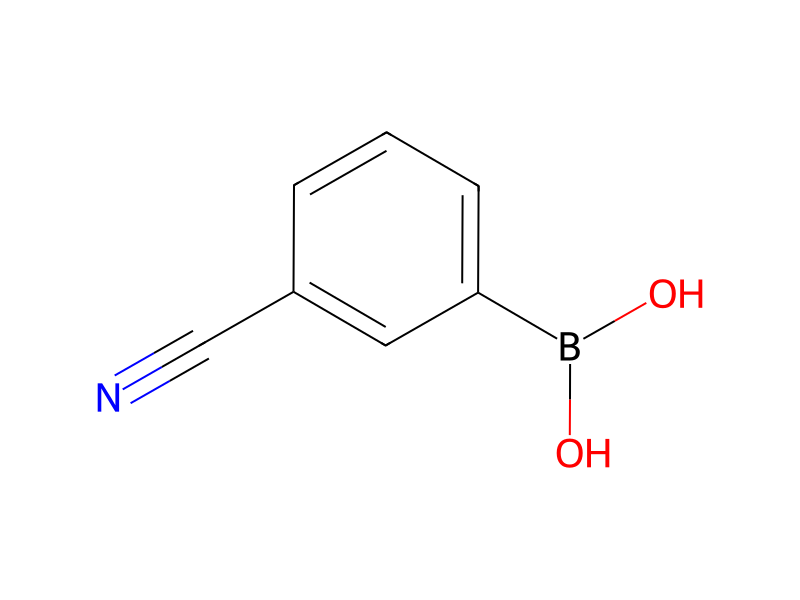
Product 1

Reagents, catalysts & solvents 2


Conditions
- Temperature
- 85 °C
Procedure
A stirred solution of 3-cyanophenyl boronic acid (812 mg) and tetrakis(triphenylphosphine) palladium (150 mg) in tetrahydrofuran (4 mL) under at atmosphere of nitrogen was treated with 4-bromo-2-nitroaniline in tetrahydrofuran (10 mL). The reaction mixture was heated at 85° C. for 48 hours, then cooled to ambient temperature and then partitioned between ethyl acetate and water. The organic layer was washed with brine, then dried over magnesium sulfate and then evaporated. The residue was subjected to flash column chromatography on silica eluting with a mixture of ethyl acetate and hexane (1:2, v/v) to give 4′-amino-3′-nitro-biphenyl-3-carbonitrile (224 mg) as a yellow solid. LC-MS (METHOD B): RT=3.21 minutes, 240.3 (M+H)+.
Workup
- temperaturecooled to ambient temperature
- custompartitioned between ethyl acetate and water
- washThe organic layer was washed with brine
- dry with materialdried over magnesium sulfate
- customevaporated
- additionThe residue was subjected to flash column chromatography on silica eluting with a mixture of ethyl acetate and hexane (1:2
Sources & evidence
- ORD record
- ord-4dbc536fc96740dda522e5d83d989a8c
- Source dataset
- uspto-grants-2012_10
- Patent number
- US08288425B2
Reaction notes
Loading…