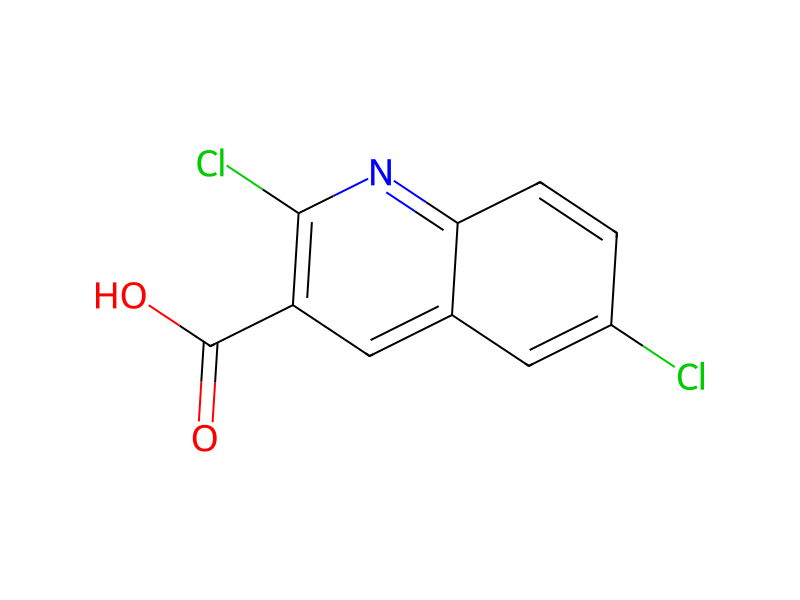
2,6-Dichloroquinoline-3-carboxylic acid → HCID 45256528, compound
Reaction equation

Cl[C:2]1[C:11]([C:12]([OH:14])=[O:13])=[CH:10][C:9]2[C:4](=[CH:5][CH:6]=[C:7]([Cl:15])[CH:8]=2)[N:3]=1.[NH2:16][C@@H:17]([CH2:21][C:22]1[CH:27]=[CH:26][C:25]([O:28][C:29]2[CH:34]=[CH:33][C:32]([Br:35])=[CH:31][N:30]=2)=[CH:24][CH:23]=1)[C:18]([OH:20])=[O:19]>CS(C)=O>[Br:35][C:32]1[CH:33]=[CH:34][C:29]([O:28][C:25]2[CH:24]=[CH:23][C:22]([CH2:21][C@H:17]([NH:16][C:2]3[C:11]([C:12]([OH:14])=[O:13])=[CH:10][C:9]4[C:4](=[CH:5][CH:6]=[C:7]([Cl:15])[CH:8]=4)[N:3]=3)[C:18]([OH:20])=[O:19])=[CH:27][CH:26]=2)=[N:30][CH:31]=1Participants
4
Reactant 2

Product 1

Reagents, catalysts & solvents 1

Procedure
In close analogy to the procedure described in Example 32; 2,6-dichloro-quinoline-3-carboxylic acid is reacted with (S)-2-amino-3-[4-(5-bromo-pyridin-2-yloxy)-phenyl]-propionic acid in DMSO to provide the title compound in good yield.
Sources & evidence
- ORD record
- ord-f18f6181a7b04ecba9ea20cc705a781a
- Source dataset
- uspto-grants-2012_10
- Patent number
- US08288549B2
Reaction notes
Loading…